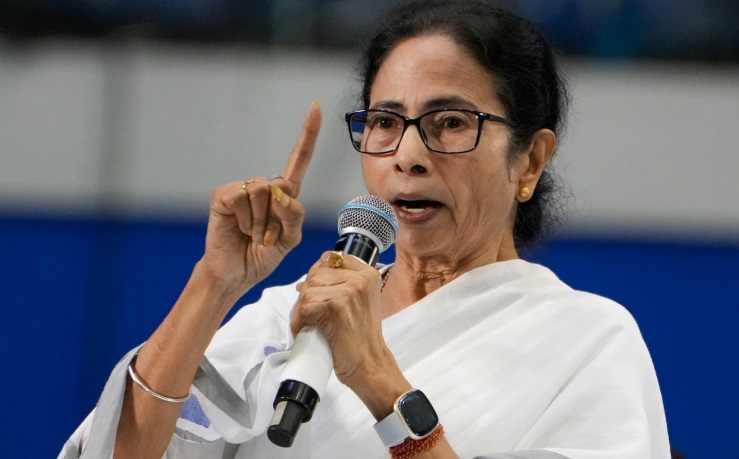
New Delhi: For nearly three decades, Mamata Banerjee has thrived on political combat. She has fought the Left, battled the Congress, taken on Narendra Modi’s BJP, survived corruption scandals, agency investigations and repeated attempts by rivals to unseat her. Through it all, the one constant that remained was her complete control over the Trinamool Congress.
That certainty now appears shaken.
The rebellion brewing within the TMC, following its electoral defeat in West Bengal, is not merely another episode of post-poll finger-pointing. If the claims of rebel MPs seeking a separate identity prove sustainable, Banerjee could be confronting a phenomenon that has humbled some of India’s most formidable political figures—the revolt from within.
Indian politics has repeatedly shown that parties rarely fall because of their enemies. More often, they are weakened by their own lieutenants.

From Indira Gandhi’s showdown with the Congress old guard to Sharad Pawar’s rebellion in Maharashtra, from Eknath Shinde’s takeover of the Shiv Sena to Ajit Pawar’s split in the NCP, the most consequential political earthquakes have often originated inside the ruling camp itself.
The lesson is as old as politics. Every political empire eventually fears not the opposition across the aisle, but the ambitious loyalist seated a few chairs away.
The Irony Of Mamata’s Predicament
The Trinamool Congress itself was born out of a rebellion. In 1998, frustrated with the Congress leadership, Banerjee broke away and founded a party that many dismissed as a regional experiment. Within 13 years, she had dismantled the seemingly impregnable 34-year Left Front regime in West Bengal and emerged as one of India’s most powerful regional leaders.
Today, the same question confronts her that once confronted the Congress leadership—what happens when those who helped build a party begin to believe they have a future outside it?
The Great Splits
Indian politics has witnessed several rebellions, but only a handful altered the course of history. The first came in 1969, when Indira Gandhi turned on the Congress syndicate. What appeared to be an organisational dispute quickly evolved into a battle for the soul of the party. The split transformed Indian politics, replacing collective leadership with the era of the supreme leader.
Nearly a decade later, a young Sharad Pawar demonstrated how ambition could rewrite power equations. His revolt against the Congress establishment in Maharashtra showed that regional strongmen could challenge even the most powerful national parties.
But the modern template for rebellion arrived in Maharashtra in 2022. Eknath Shinde’s revolt against Uddhav Thackeray was not merely a split. It was a hostile takeover. Armed with a majority of MLAs, Shinde not only brought down a government but also eventually secured the party name and symbol, proving how arithmetic often matters more than legacy or ideology in contemporary politics.
The Ajit Pawar revolt against his uncle Sharad Pawar a year later reinforced the same lesson. Political inheritance, it turned out, was no guarantee against rebellion.
Why Revolts Happen
Every successful rebellion follows a familiar script. It begins with electoral setbacks, leadership fatigue or succession disputes. The loyalists start questioning strategy. Access to the supreme leader becomes a source of grievance. Younger leaders begin to see a ceiling above them. Rivals outside the party sense opportunity.
What follows is often less ideological than practical. Rebels rarely leave because they disagree with a party’s principles. They leave because they no longer believe their future lies within the existing structure.
That is why defections are often strongest immediately after defeats. Victory suppresses differences. Defeat magnifies them.
The Bengal Question
Whether the current unrest in the TMC becomes another footnote or joins the ranks of India’s great political schisms will ultimately depend on numbers. History offers examples of both outcomes. Many rebellions collapse because the rebels overestimate their support. Others succeed because the leadership underestimates the depth of discontent.
For Mamata Banerjee, the challenge is larger than managing a handful of dissidents. It is about preserving the aura, the belief that the party’s future is inseparable from their own, that every dominant leader depends upon. History suggests that even the strongest political fortresses can begin to crack the moment that belief begins to erode.
And when they do, the most dangerous opponents are rarely outside the walls. They are already inside.