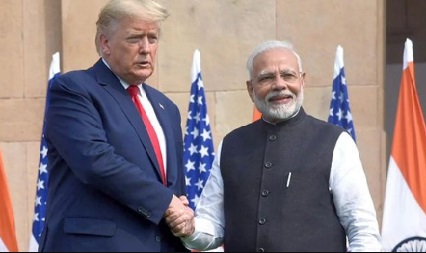
New Delhi : Amid ongoing trade tensions between India and the US, Prime Minister Narendra Modi on Thursday held a telephonic conversation with US President Donald Trump, during which the two leaders reviewed the progress of the Comprehensive Global Strategic Partnership between Washington and New Delhi.
Both expressed satisfaction at the steady strengthening of bilateral cooperation across all domains.
Giving a brief account of his conversation with Trump, Prime Minister Modi took to X and wrote: “Had a very warm and engaging conversation with President Trump. We reviewed the progress in our bilateral relations and discussed regional and international developments.”
He ended the post by stressing that India and the US “will continue to work together for global peace, stability and prosperity.”

PM Modi and Trump underlined the importance of maintaining momentum in their shared efforts to enhance bilateral trade. They also exchanged views on expanding collaboration in critical technologies, energy, defence and security, and other priority areas central to the implementation of the India-US COMPACT (Catalysing Opportunities for Military Partnership, Accelerated Commerce & Technology) for the 21st century.
The leaders discussed various regional and global developments and agreed to work closely to address shared challenges and advance common interests. They also agreed to remain in touch.
The phone call between the two leaders took place on a day when the US negotiators opened two days of trade talks in New Delhi. A top American official in Washington said India has put forward its strongest proposals yet for a long-pending bilateral pact.Testifying before the Senate Appropriations Committee, US Trade Representative Jamieson Greer called India a “tough nut to crack” but said the Modi government’s latest market-access offer is the “best ever” the US has seen.
“There’s resistance in India to certain row crops and other meats and products. Like you said, they’re a very difficult nut to crack. I agree with that 100 per cent,” Greer told lawmakers.
“But they’ve been quite forward leaning. The type of offers they’ve been talking to us about have been the best we’ve ever received, as a country,” he added.
Greer said a US delegation is in New Delhi this week to work through the remaining friction points, particularly India’s resistance to American farm goods, meat and dairy products. Despite those hurdles, he said Washington now sees India as a “viable alternative market” as the US looks to diversify trade channels.
The delegation, led by Deputy US Trade Representative Rick Switzer, began meetings on Wednesday with India’s chief negotiator and Commerce Department Joint Secretary Darpan Jain. Commerce Secretary Rajesh Agrawal is overseeing the negotiations.
Commerce and Industry Minister Piyush Goyal said the talks are moving steadily. “Talks are continuously progressing with them. We are moving forward towards a bilateral trade agreement,” he told reporters on Wednesday. He hinted that he may meet the visiting American team.
The visit is critical as both sides push to finalise the first tranche of a framework trade deal this year. It also comes on the heels of a sharp escalation in trade tensions: the US has imposed a 25 per cent tariff and an additional 25 per cent penalty on Indian goods linked to New Delhi’s purchase of Russian oil — a combined 50 per cent levy that is among the highest slapped on any partner.
Earlier this week, US President Donald Trump threatened fresh tariffs on Indian rice after a farmer representative at a White House roundtable complained of dumping by India, China and Thailand. “Why is India allowed to do that? They have to pay tariffs. Do they have an exemption on rice?” Trump asked Treasury Secretary Scott Bessent.