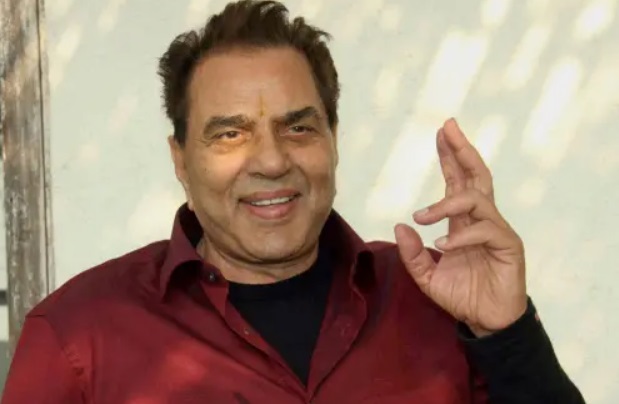
New Delhi : Before Dharmendra, India’s screen gods were tragic heroes. Dharmendra came on to the scene, took his shirt off, owned his sexuality, made people gawk at his Greek-god looks, and left an impression any actor seldom had until then. For the Indian cinemagoer, the game had changed. Cinema had a new religion. It was called Dharam.
Garam, Naram, the adjectives for Dharam were many. The epithets more: Greek god, son of the soil, family man, a man who wore his heart on his sleeve. He fit all of them like a glove. He lived a full life. He loved like there was no tomorrow. And when he appeared on screen with his seeti-maar dialogues, the Indian audience responded with taalis. He did so for six decades. Over 300 films. Many, many hits. And ninety years of holding the Indian moviegoer in thrall.
On November 24, Dharmendra said a final goodbye to his extended family–his audience–two weeks shy of his 90th birthday.
Dharmendra: A Dream Come True
Dharmendra’s story of coming to Mumbai and becoming one of India’s most popular stars is the stuff of dreams.

It was screen icon Dilip Kumar who inspired Dharmendra, a simple village boy from Nasrali, Punjab’s Ludhiana district, to become an actor. One of the first films that left an indelible mark on young Dharmendra was 1948’s Shaheed, starring Dilip Kumar.
He later got a chance to work with his idol, who became like an elder brother, in 1966’s Paari (Dharmendra’s first Bengali film) and its Hindi remake Anokha Milan (1972).
A young Dharmendra, born Dharmendra Kewal Krishan Deol, would ride around the village on his bicycle looking for his likeness on film posters pasted on walls. He would lie awake at night with dreams in his eyes to make it big in Bombay.
“I would dream the impossible dream and ask the mirror in the morning, ‘Can I become Dilip Kumar?'” he once said.
In 1958, Dharmendra won the talent contest organised by Filmfare magazine, the winners of which were to be launched in a new film. But, as fate would have it, that promised film never saw the light of day. He got his big break two years later in Arjun Hingorani’s Dil Bhi Tera Hum Bhi Tere.
Early Struggles
But his journey in movies was not without struggle. He would walk miles to get to producers’ offices and often survive by eating only chana for days. “In my earlier days, I used to live in a garage because I didn’t have a proper home in Mumbai. To survive, I worked in a drilling firm where I was paid Rs 200, and to earn extra money, I used to do overtime.”
It’s hard to believe, but Dharmendra played many common-man roles in the 1960s in movies such as Anpadh, Bandini, Anupama, and Aaya Sawan Jhoom Ke, before graduating to macho-men protagonists in action films like Sholay, Dharam Veer, Phool Aur Patthar, Mera Gaon Mera Desh, and Seeta Aur Geeta.
1966’s Phool Aur Patthar was his first big hit, where he shocked audiences by delivering a shirtless scene – something that earned him both criticism and praise.
“I Don’t Know What It Means To Be A Greek God”
Dharmendra once said he didn’t really know the meaning of “Greek god,” a term he was called decades before Hrithik Roshan took on that mantle.
“I have always broken my image every time I go on screen. I don’t believe I have an image. I don’t know what it means to be a Greek god, but people used to call me one. People have given me a lot of love, but I never got high on it. Love has given me a strong foothold, and I try to maintain this love; I hope it never wears away,” the veteran actor said.
Like other actors of the 1960s-70s era, once Dharmendra became popular for his massy and He-Man persona, his acting became largely theatrical dialogue-baazi that would elicit whistles in theatres. His passionate performance style earned him the nickname “Garam Dharam.” He later used this moniker to start a chain of Bollywood-style restaurants called Garam Dharam Dhaba.
Dharmendra: The Macho Man Who Fell For The Dream Girl
Besides his looks and acting style, Dharmendra dominated headlines in the ’70s and ’80s for his relationship with Hema Malini, his frequent co-star in films such as Sholay, Seeta Aur Geeta, and Dream Girl. Dharmendra was already married to Prakash Kaur, and the couple had sons Sunny and Bobby, and daughters Ajeeta and Vijeta. It was rumoured he converted to Islam to marry Hema Malini in 1980. They have two daughters, Esha and Ahana. Years later, Dharmendra rubbished his conversion rumours.
Dharmendra, who famously inspired Salman Khan to take up bodybuilding, had a softer and funnier side that emerged under filmmakers like Hrishikesh Mukherjee, notably in Guddi and Chupke Chupke. He remained relevant in the ’80s with films such as Naukar Biwi Ka, Ghulami, Insaniyat Ke Dushman, and Loha. By the mid-1990s, his stardom waned with lukewarm performances in Maidan-E-Jung and Return of Jewel Thief.
In 1983, Dharmendra launched his production house Vijayta Films with the debut of his son Sunny Deol in Betaab. Twelve years later, he launched his younger son Bobby Deol in Barsaat. Walking in his footsteps, albeit under a different banner of Sunny Sound Pvt Ltd, Sunny Deol also launched his son Karan Deol in 2019 with Pal Pal Dil Ke Paas, whose title drew inspiration from Dharmendra’s popular song of the same name from his 1973 film Blackmail.
By the 1990s, Dharmendra embraced character roles in films such as Pyaar Kiya To Darna Kya, Life in a… Metro, Apne, and the Yamla Pagla Deewana franchise alongside Sunny Deol and Bobby Deol.
Dharmendra’s Political Plunge
Dharmendra also had a brief political career, serving as BJP MP from Bikaner, Rajasthan, from 2004 to 2009. During his election campaign, he was humorously called out for saying he should be elected ‘Dictator Perpetuo’ to teach “basic etiquette that democracy requires”. Despite being awarded the Padma Bhushan in 2012, he faced criticism for his absence from Parliament.