New Delhi: More than 18,000 feet above sea level, where the air is razor-thin, and no landing ground existed, two soldiers jumped into the void, after a brief prayer. Armed to the teeth, and dressed in basic extreme winter gear, they looked down at an endless expanse of snow before jumping from hovering IAF’s Cheetah helicopters.
This is how Captain Sanjay Kulkarni of 4 Kumaon Regiment and his radio operator were inserted onto the Siachen Glacier, even as another platoon climbed on foot to take positions. It was April 1984 and the mission was to secure the glacier before Pakistani troops could move in. The account is documented by Colonel Ajay Singh (Retired), in his book, India’s Battlefields: From Kurukshetra to Balakot.
Operation Meghdoot, which began in 1984, has been on ever since. It has been 42 years since the operation, which cemented the foothold of Indian forces on the world’s highest battlefield, was launched.
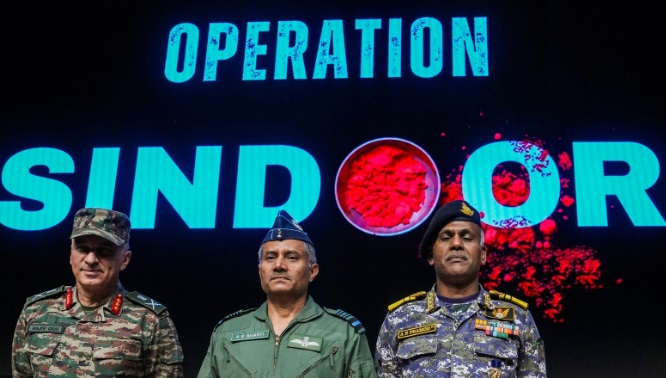
We revisit Operation Meghdoot, often regarded as the longest-running mission of the Indian Army, as we mark a year of the commencement of Operation Sindoor, which was India’s retaliatory strike on Pakistani terror hideouts.

Chief of Army Staff, Upendra Dwivedi, said earlier this year, said, “Operation Sindoor remains ongoing, and any misadventure by the adversary will be dealt with effectively.” The warning came in January, months after the guns had fallen silent after the brief four-day-long military mission. Operation Sindoor was launched after Pakistani terrorists killed 26 civilians in Pahalgam in April 2025. The Indian retaliation, the military said, is not a closed chapter.
There are operations that end with the mission, and there are operations that redefine how a nation responds to threats from a rogue adversary. Operation Sindoor obliterated Pakistan’s air defence infrastructure and terror hubs in just 22 minutes. Defence strategist and internal security expert, Lieutenant General Dushyant Singh (Retired), said, “Operation Sindoor 2.0” is not just possible, it is “inevitable”.
While Operation Sindoor continues, this is not the first time the Indian military has remained locked in an indefinite military campaign. Operation Meghdoot, which started four decades before Operation Sindoor, never truly ended as the Pakistani threat over Siachen never fully disappeared.
Launched 42 years ago on April 13, 1984, it is India’s longest-running military mission. While the world’s attention keeps shifting to newer conflicts, thousands of Indian soldiers still guard the world’s highest battlefield, under conditions that test human endurance to its limits. India’s daily expenditure on Siachen at around Rs 5 crore, according to reports.
On the first anniversary of Operation Sindoor, we revisit one of the toughest military missions ever accomplished anywhere in the world.
WHY INDIA LAUNCHED OPERATION MEGHDOOT? WHY IS SIACHEN SO IMPORTANT TO INDIA?
In the early 1980s, the 76-km-long river of ice sheet in the Karakoram range, the Siachen Glacier, although an Indian territory, remained in a grey zone due to a technicality. The 1949 Karachi Agreement had left the area beyond map point NJ9842 undemarcated. Pakistan began showing cartographic aggression, issuing permits to foreign mountaineers and planning its own military movement, codenamed Operation Ababeel.
Under Operation Ababeel, the Pakistan Army had a plan to capture the strategic glacier before India could secure it, and seize key positions across the glacier and dominate the strategically vital Saltoro Ridge. The Saltoro Ridge is a towering structure that overlooks the entire Siachen region and determines military control of the area.
Indian intelligence picked up these signals. Under the leadership of Lieutenant General Prem Nath Hoon and with the approval of Prime Minister Indira Gandhi, the Indian Army decided to act first and fast.
But first, let’s understand why this remote, barren glacier mattered so much, and still matters.
Siachen is not just a piece of ice. It is a strategic shield. The Saltoro Ridge, where Indian troops have been deployed since 1984, is at an altitude ranging between 15,000 and 22,000 feet. The possession of the strategic glacier gives India a commanding view over the region, which acts as a natural wedge between Pakistan-Occupied Kashmir (POK) and the Shaksgam Valley, which Pakistan captured and illegally ceded to China in 1963.
By holding these heights, India prevents any direct physical or military linkage between Pakistan and China at this critical tri-junction. The glacier also dominates key approaches to Ladakh.
Losing it would expose vital mountain passes and make the defence of Leh and surrounding areas far more difficult. Moreover, it provides India with a tactical advantage of “the high ground”. Pakistani troops remain at lower altitudes and are largely blind to movements on the Indian side.
In military terms, this is a priceless edge. As long as Indian forces stay on the Saltoro Ridge along the Actual Ground Position Line (AGPL), no surprise incursions can easily succeed. Siachen, in short, is India’s forward defence line in one of the most sensitive borders in the world.