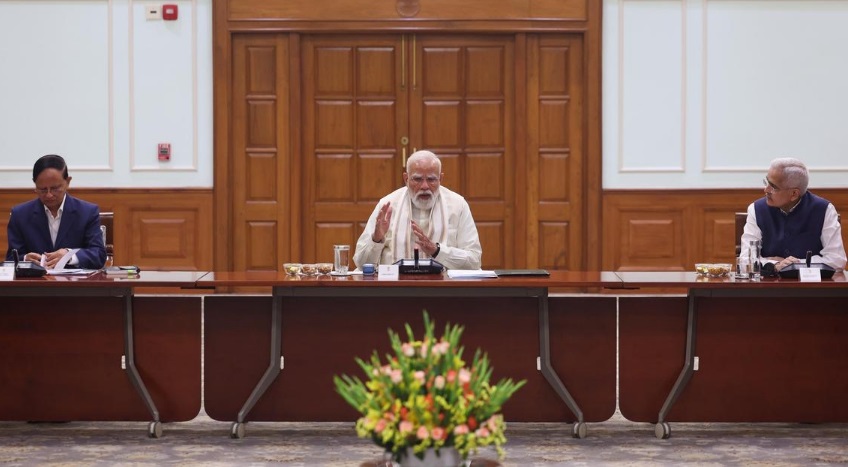
New Delhi: Prime Minister Narendra Modi on Saturday held a meeting with members of his Economic Advisory Council to the Prime Minister (EAC-PM) to discuss strategies for strengthening India’s economic growth amid ongoing global uncertainties and energy supply issues brought on by the West Asia conflict.
According to sources, the meeting focused on a range of ideas and policy measures aimed at sustaining economic momentum and enhancing India’s growth prospects despite challenges in the global economy.
The discussions also covered reforms designed to improve the ease of living for citizens and further enhance the ease of doing business in the country. Participants reviewed ongoing economic trends and explored ways to accelerate development while maintaining macroeconomic stability.
Members of the EAC-PM shared their assessments of the evolving international economic environment and its potential implications for India. Particular attention was given to the impact of the ongoing conflict in West Asia on global markets, trade flows, energy security and economic growth.

The council members also presented their views on how geopolitical developments could affect both the Indian economy and the broader global economic landscape.
The meeting comes at a time when economies around the world are grappling with geopolitical tensions, supply chain disruptions and uncertainty in international markets due to the US-Iran conflict and the closure of the Strait of Hormuz.
US-Iran conflict escalates
The United States military said it intercepted four Iranian drones that were allegedly launched toward the Strait of Hormuz on Friday before carrying out strikes on several Iranian coastal surveillance radar installations, marking a fresh escalation in tensions between Washington and Tehran.
According to US Central Command, the drones posed an immediate threat to maritime traffic in the strategically vital waterway, through which a significant portion of the world’s oil and natural gas shipments pass.
“The attack drones posed an immediate threat to regional maritime traffic,” the command said in a statement posted on social media.
Following the drone interceptions, US forces targeted a number of Iranian radar sites, including one located on an island in the Strait of Hormuz. The military said the strikes were conducted to prevent further attacks and protect navigation in the region.
The latest exchange has heightened concerns about the stability of an already fragile ceasefire and raised fears of renewed confrontation between the two countries.