New Delhi: Tamil Nadu Chief Minister C Joseph Vijay on Thursday attended the 11th Governing Council meeting of NITI Aayog at the Rashtrapati Bhavan Cultural Centre in New Delhi, signalling a departure from the approach adopted by the previous DMK government towards the Centre.
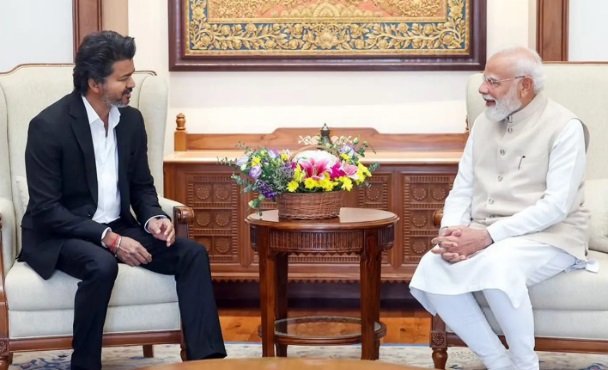
Following the huddle, Vijay held a separate meeting with Prime Minister Narendra Modi. It was the Chief Minister’s second meeting with the Prime Minister in less than a month.Soon after assuming office last month, Vijay travelled to New Delhi and met PM Modi on May 27, seeking financial support for welfare and infrastructure projects, clearances for key developmental initiatives and intervention in the contentious Mekedatu water dispute. He also met Union Finance Minister Nirmala Sitharaman, seeking greater budgetary support for Tamil Nadu.
At the NITI Aayog meeting today, Vijay reiterated Tamil Nadu’s opposition to the National Eligibility-cum-Entrance Test (NEET) for admissions to undergraduate medical and dental courses. He argued that the examination had adversely affected students from rural backgrounds and socio-economically disadvantaged sections.
The Chief Minister urged the Centre to allow Tamil Nadu to fill all seats under the state quota in MBBS, BDS and AYUSH courses solely on the basis of Class XII marks.

How Vijay Is Charting A New Course For Tamil Nadu-Delhi Ties
While Vijay had described the BJP as his party’s “ideological enemy” during the Tamil Nadu Assembly election campaign, his conduct after assuming office has reflected a more pragmatic approach towards the Centre.
Unlike several opposition leaders who directly targeted the BJP-led Union government over the NEET-UG examination controversy, Vijay confined his criticism to what he described as “conclusive proof of flaws and structural deficiencies” in the national-level examination system, without launching a direct attack on the Centre.
Similarly, in his maiden speech in the Tamil Nadu Assembly as Chief Minister, Vijay refrained from criticising either the BJP or the Union government.
The contrast with his predecessor, MK Stalin, is notable. Stalin skipped three consecutive NITI Aayog meetings, alleging that Tamil Nadu was being subjected to “step-motherly treatment” by the Centre.
Early Signals
It is still too early to draw definitive conclusions about the trajectory of the Vijay government, which has just begun its five-year term. However, the Chief Minister’s decision to engage directly with the Centre, attend NITI Aayog meetings and maintain regular communication with the Prime Minister suggests an effort to prioritise cooperation over confrontation while continuing to assert Tamil Nadu’s interests on key issues such as NEET and fiscal allocations.
Whether this approach translates into greater benefits for the state remains to be seen, but the early signs point to a recalibration in Tamil Nadu’s relationship with New Delhi.