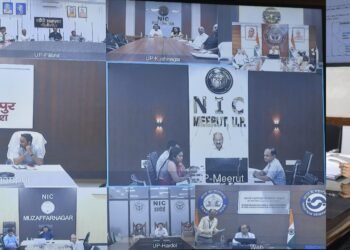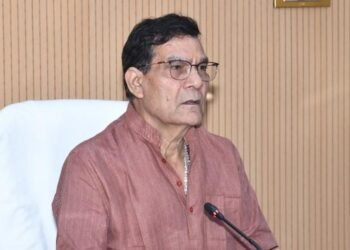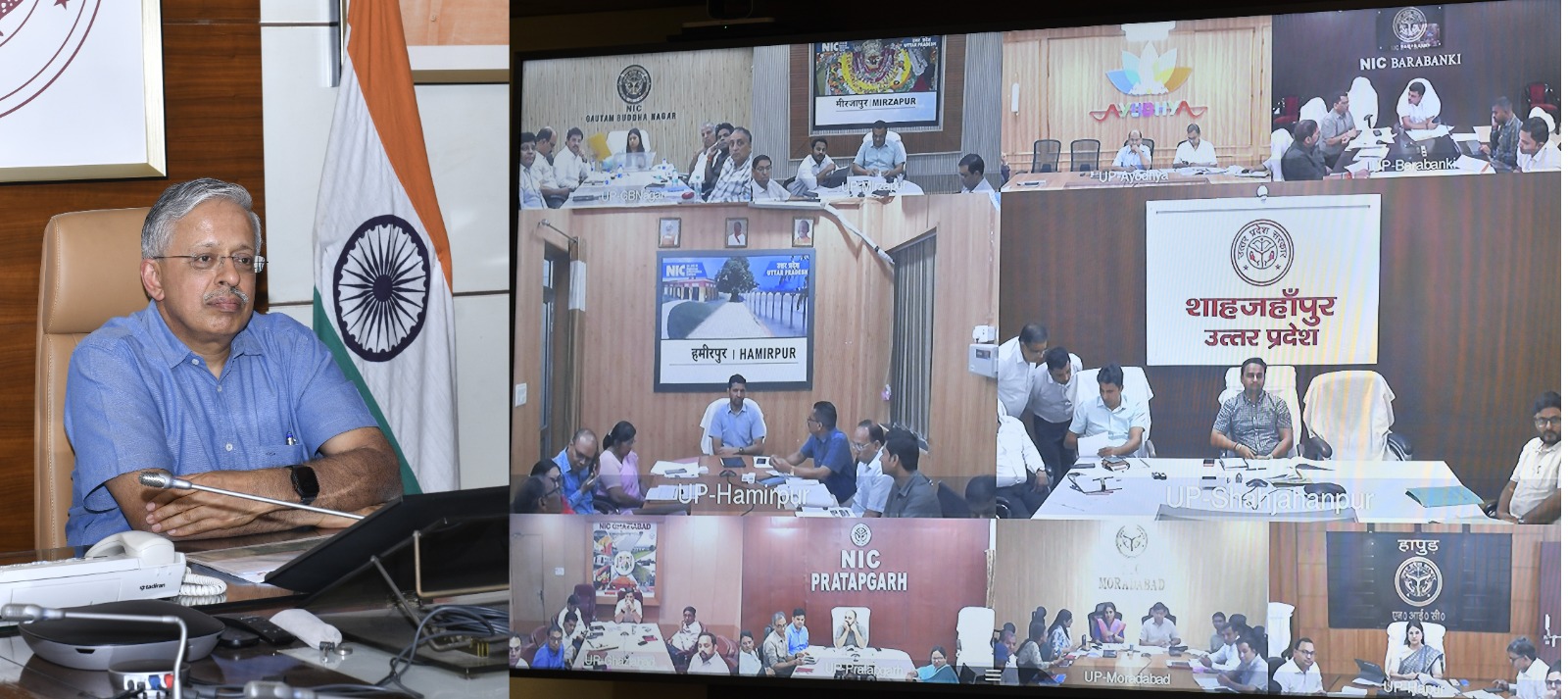
Sachin Malik: Uttar Pradesh Chief Secretary S.P. Goyal conducted the weekly review meeting through video conferencing with all Divisional Commissioners, District Magistrates and Senior Police officers across the State, issuing a Series of important Directives.
Reviewing the Preparations for the NEET examination Scheduled to be held on 21 June across 59 districts of Uttar Pradesh, the Chief Secretary emphasized that, considering the large number of candidates expected to Participate, all arrangements must be made with utmost Vigilance and Sensitivity. He directed officials to ensure that all facilities are Provided in accordance with the Guidelines of the National Testing Agency (NTA) and that the examination is conducted in a Peaceful, fair and transparent Manner.
He Instructed authorities to deploy an adequate number of male and female Police Personnel at examination centres and to ensure Sufficient Security and traffic management at railway Stations, bus terminals, major intersections and examination venues to facilitate the Smooth movement and Safety of Candidates.
Reviewing the Ayushman Bharat–Pradhan Mantri Jan Arogya Yojana, the Chief Secretary directed officials to ensure 100 Percent issuance of Ayushman cards for all eligible beneficiaries aged 70 Years and above under the Vaya Vandana Scheme. He also instructed the development of a data correction Portal to address name discrepancies during E-KYC verification and directed officials to identify and issue cards to all eligible beneficiaries, including ASHA workers, Anganwadi workers, helpers and other left-out Beneficiaries.

He further directed the Chief Medical Officers (CMO) and Chief Development Officers (CDO) to regularly monitor the Scheme and ensure a Steady increase in the number of Ayushman cards issued each Day.
The Chief Secretary announced that the State Government will establish “Sardar Vallabhbhai Patel Employment and Industrial Areas” across Uttar Pradesh with the objective of making the State a national hub for Skill development, entrepreneurship and industrial Growth. These integrated Zones will include Skill Development Centres, MSME industrial Plots, Common Facility Centres, Driver Training Centres, Employment Buildings, District Industries Centres, Health Centres, Fire Stations, Plug-and-Play facilities and other modern Infrastructure.
For this Initiative, Uttar Pradesh has been divided into nine regional Zones. Zone 1 includes Gautam Buddh Nagar, Ghaziabad, and Hapur, Zone 2 covers Bulandshahr, Baghpat, Meerut and Saharanpur Division, Zone 3 includes Moradabad and Bareilly Divisions, Zone 4 covers Agra and Aligarh Divisions, Zone 5 comprises Lucknow and Ayodhya Divisions, Zone 6 includes Kanpur and Prayagraj Divisions, Zone 7 covers Varanasi, Vindhyachal and Azamgarh Divisions, Zone 8 includes Jhansi and Chitrakoot Divisions and Zone 9 comprises Gorakhpur, Basti and Devipatan Divisions.
District Magistrates were directed to identify and make available Suitable land ranging from 50 to 100 acres for the MSME Department at the Earliest.
Reviewing the Business Reform Action Plan, the Chief Secretary instructed officials to ensure timely and digital delivery of services available on the Nivesh Mitra Portal. He emphasized timely uploading of inspection reports, establishment of help desks at District Industries Centres (DIC), Prompt resolution of investors’ Grievances and the creation of Startup Cells to Promote innovation, mentoring and financial Assistance.
The Chief Secretary also directed officials to ensure that Public Grievances are resolved with complete sensitivity, transparency, and Quality. He instructed all district-level officers to conduct Public hearings on Schedule and ensure that every complaint received is mandatorily registered on the IGRS Portal. District Magistrates were asked to ensure that subordinate officers also remain available for Grievance hearings as Per the Prescribed Schedule.
He instructed District Magistrates to obtain feedback on at least 10 complaints every day, conduct special reviews of cases receiving unsatisfactory feedback and ensure Quality disposal of Grievances. He also directed that accountability be fixed for officials Who Close complaints improperly or against Prescribed Rules. Competent officers Should be appointed as nodal officers and Portal operators Should be adequately Sensitized.
The Chief Secretary informed that an Artificial Intelligence (AI)-based system is currently being tested for effective monitoring and disposal of Public Grievances at both the State and district levels. The system will soon be integrated with the IGRS Portal and will assist officials by summarizing complaints and suggesting Possible Solutions.
He further informed that a special campaign is being conducted from 1 June to 30 June for the effective resolution of land disputes. Under the campaign, Pending revenue land-related cases available on the IGRS Portal for the Period from 1 April 2025 to 31 March 2026 are being revived to facilitate their disposal. A village-wise list is available on the Portal and officials have been instructed to examine the list, revive eligible cases and dispose of them Promptly. Revenue court cases Pending under this category Should be accorded the highest Priority.
Senior officials from the concerned departments also attended the Meeting.