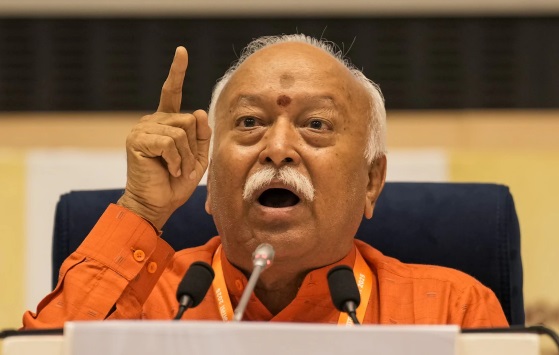
New Delhi: RSS chief Mohan Bhagwat’s tightly-packed Manipur tour is not a routine organisational engagement, as it happened after years. It is a calibrated move on the part of the Sangh that could shape the state’s political and administrative future.
Signals had already been emanating from Nagpur, the RSS headquarter and from the substantial corners of Delhi over the past few weeks, but the RSS Sarsanghchalak’s 48-hour visit stitches them into a coherent political message. What happens in Manipur next will now be determined as much by the Sangh’s reading of the ground as by the Centre’s calculus. And, Bhagwat’s presence bridges both.
The first hint came when RSS general secretary Dattatreya Hosabale, speaking after the organisation’s Akhil Bharatiya Pratinidhi Sabha (ABPS) in Jabalpur, declared that Manipur was “ready to get its government back and the people are willing.”
The statement was unusually direct and came at a moment when the state remained under political uncertainty. Hosabale’s words were interpreted as a nudge to the Centre that restoring the elected government may now be administratively feasible and socially acceptable as well. For Manipur’s political class, this was the first smoke signal that the Sangh now wants normalcy to be restored through political reinstatement, not prolonged central control.

The Strategic Visit of BL Santhosh
Barely weeks after Hosabale’s remark, BJP general secretary (organisation) BL Santhosh arrived in Manipur to meet the local organisations. His visit, though low-profile, was read internally as a serious ground assessment exercise.
Santhosh’s role, particularly in conflict-hit states, is to judge cadre morale, security perception, and also the political timeline required for re-activating election machinery. His Manipur tour indicated that the party and the Sangh were synchronising notes while preparing for a decisive move.
Bhagwat’s Manipur Push
Bhagwat’s arrival now appears to be the culmination of this sequence. The Sarsanghchalak does not visit conflict zones unless the Sangh has reached a conclusion on the roadmap ahead.
Over the next two days, he is scheduled to meet civil society, intellectuals, community leaders and selected representatives, mostly a cross-section of groups, large enough to gauge whether Manipur’s social fabric is strong enough to support a political reboot. His conversations in Imphal will likely shape the final recommendation to the Centre: reinstate, recalibrate, or reset.
The Biren Singh Question
One of the biggest questions now is whether the RSS will back the state’s Chief Minister N. Biren Singh’s continuation if the government is restored.
The Sangh has kept its cards close, but insiders suggest that the organisation is not opposed to Biren returning if stability can be ensured. In fact, on several other earlier occasions, the Sangh extended its support to Singh.
Alternatively, if divisions remain too sharp, the state could be nudged toward elections, and may look for a fresh mandate to rebuild political legitimacy. Bhagwat’s meetings may settle this question.
A Return to Democratic Normalcy
Apart from the social-political readings, there is also an administrative signal. If the RSS gives the go-ahead, and if everything syncs, Manipur may resume several activities suspended during the crisis, including grassroots democratic processes.
The last panchayat elections were held in 2017, the return of such institutions will be viewed as the clearest indicator that the state is moving back to normalcy.
Bhagwat’s Manipur visit is, therefore, not a symbolic exercise. It is the final diagnostic check before the state’s political engine restarts. The next 48 hours in Imphal may quietly script Manipur’s next defining chapter.