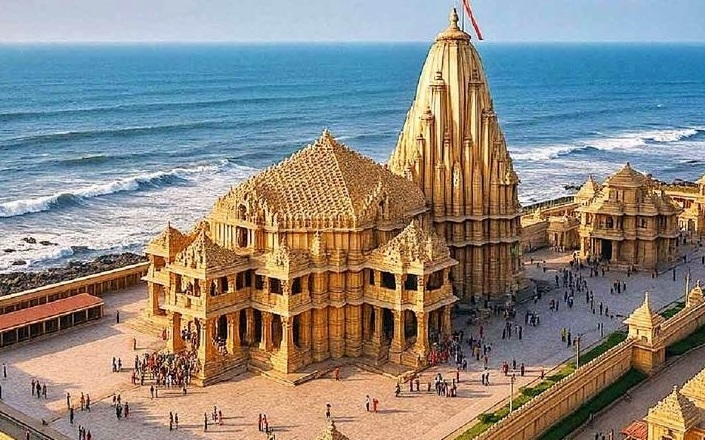
New Delhi: Long before modern banks existed, temples often stored enormous wealth in the form of gold, silver, jewels, and donations from kings and merchants. Somnath was one of the richest temples in medieval India.
The temple is believed to be the first Jyotirlinga of Lord Shiva, making it one of Hinduism’s holiest pilgrimage sites. The inscription on it claims that there is no landmass between Somnath and Antarctica in a straight line across the ocean.
Ancient travelers wrote that the sound of Somnath’s bells could supposedly be heard from miles away over the sea.
According to Hindu mythology, the temple’s story began with the Moon God, Soma. Legend says Soma built the first temple in gold after being freed from a curse by Lord Shiva.

The temple was then supposedly rebuilt:
In silver by Ravana, In the woods by Lord Krishna, And finally in stone by kings of ancient India.
Though these accounts belong to mythology rather than verified history, they add to Somnath’s mystical a
The earliest recorded attack on Somnath likely came during Arab invasions in western India around the 8th century. Though damaged, the temple was rebuilt by local rulers.
The most talked-about attack happened in 1025 CE when Mahmud of Ghazni invaded Gujarat. Historical records describe how Mahmud marched across the desert with thousands of soldiers to reach Somnath. Chroniclers claim the temple contained immense riches, including gold chains, precious stones, and treasures donated by devotees.
After defeating defenders of the temple, Mahmud looted the wealth and destroyed the sacred idol.
Some medieval accounts say the temple gates were made of sandalwood and decorated with precious metals, though historians debate parts of these descriptions.
The attack became one of the most symbolic events in medieval Indian history.
Despite the destruction, the temple did not remain in ruins for long. The Solanki rulers of Gujarat rebuilt Somnath, restoring worship and pilgrimage activities. But the temple would face more attacks in later centuries during the rule of the Delhi Sultanate.
For invaders, Somnath represented not just wealth but also political power and religious influence.
In the late 13th century, armies linked to Alauddin Khalji attacked Gujarat. Somnath again suffered destruction. Over the next few centuries, regional wars and changing rulers repeatedly affected the shrine. Yet local communities and Hindu rulers continued rebuilding it.
Historians often describe Somnath as one of the few temples whose reconstruction became a political statement of resistance and cultural identity.