NEW DELHI : ‘Paradise. Paradise. Paradise.’ Not the famous Hyderabadi biryani this time, but Nani and Srikanth Odela’s film. For months, the name has been everywhere. And it is not just because of Nani. From the very first glimpse of the film’s world to the songs Aaya Sher and Yeshanagula, The Paradise has managed to create the kind of anticipation that few films sustain this far ahead of release.
Aaya Sher became more than a song from a film. It escaped the promotional campaign and became a cultural moment of its own. Then came Yeshanagula, with its Telangana folk influences and infectious energy, adding another layer to the film’s growing popularity. The song crossed 122 million YouTube views and was reported to have topped YouTube’s global charts.
But while the music kept the excitement alive, the film’s production journey raised questions. The Paradise has gone through multiple release-date changes, moving from March 26 to August 21 and eventually to September 24. Reports about pending VFX and technical work, particularly around its CG-heavy climax, fuelled speculation that even the latest date could change.
Those concerns should not simply be dismissed as social media negativity. A film that takes this long, changes release dates and reportedly continues substantial post-production close to release naturally gives audiences reason to worry. There is a difference between a baseless rumour and legitimate questions about whether a large-scale production has had enough time to come together.

The makers have reaffirmed September 24, and the film has now received an A certificate with a reported runtime of two hours and 54 minutes. Nani has also said the team chose not to release a trailer because they did not want to rush the process, with the focus instead being on completing the film to their desired quality.
That leaves The Paradise in an interesting space. There are reasons to be cautious, but there are equally tangible reasons to remain curious.
A world that demands attention
Srikanth did not rely only on dialogue to establish the world of Dasara(2023). The setting, the people, the alcohol ban, the social hierarchy and even smaller visual references became part of the storytelling. The world around Dharani, Suri and Vennela constantly revealed something about them. Even the Silk Smitha reference worked because it belonged to the world they inhabited rather than feeling like a forced nostalgic callback. The Paradise appears to be taking that approach further.
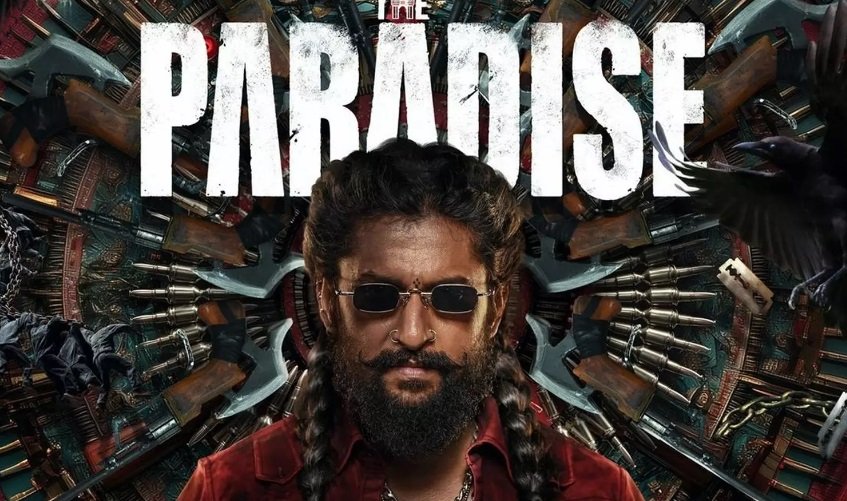
Look at the frames released so far. The crow, the rain, the tree, fire, dump yards, houses, crowded streets and Telangana cultural elements all seem to carry meaning. The traditional dance forms and the way these characters occupy their surroundings suggest a world with its own history and social structure. And then there are the dialogues.
In the birthday glimpse, Srikanth says, “History is written when blood is spilled on it.” Suddenly, the violence in those frames feels less like style and more like a consequence of the history these characters have inherited. Another line from Srikanth adds to that idea. He described the story as being about people who fought for the country but were forgotten by their own people, leading to their revolution.
If the film delivers on that idea, the fire, the violence and the rebellion are not merely there to create mass moments. They are part of a larger history. And that is what makes the world of The Paradise worth watching beyond how good it looks.
The easiest thing to notice about Srikanth Odela is his rawness. But the most important quality he demonstrated in Dasara was his ability to build emotion. Think of Vennela, Suri and Dharani. Their relationships were not merely devices to move the plot forward. The characters carried histories, frustrations and emotional dependencies that made the film’s biggest moments work. The violence in Dasara had an impact because the emotional groundwork had already been laid.
That is particularly relevant to The Paradise, because the team has described it as a mother-and-son story at its heart. Behind Jadal’s violence and rebellion is his relationship with his mother Sammakka, played by Sonali Kulkarni. Around them are characters played by Raghav Juyal, Kayadu Lohar, Sampoornesh Babu and Mohan Babu.
If Srikanth can bring the same emotional investment to these relationships that he did in Dasara, the film could have something more valuable than spectacle. It could have characters worth caring about.
The Anirudh factor
And then there is Anirudh Ravichander, who seems to be on another streak. From Coolie to DC and now The Paradise, everything around his recent work is generating noise, and the songs from The Paradise are no exception. Aaya Sher and Yeshanagula have already caught fire, with the latter crossing 122 million views on YouTube.
But Anirudh’s biggest strength has always been what he does beyond the songs. His background score can completely change the energy of a scene, and that is perhaps where the real excitement around The Paradise lies. Only two or three songs have been released so far, while the film is said to have nearly nine tracks, including shorter pieces. If what we have heard already is this infectious, there is genuine curiosity about what Anirudh is cooking for the film’s background score.
Nani is no longer playing it safe
For years, Nani’s greatest strength was his relatability. From Ala Modalaindi (2011) and Bhale Bhale Magadivoy (2015) to Evade Subramanyam (2015) and Hi Nanna (2023), he built an image around characters audiences could easily identify with.
Then he began pushing against it. V (2020) was an early attempt to move into darker territory. Dasara took that experiment much further. Nani’s Telangana dialect, physical transformation, anger and drunkenness challenged the familiar image audiences had built around him.
The Paradise feels like another step. Jadal has already become recognisable through his hair, tattoos, styling and physicality. But the interesting part is not the look. It is the willingness to inhabit a character who appears to belong to an entirely different world from the Nani audiences grew up watching. That requires trust in the filmmaker. And Nani appears to have placed considerable trust in Srikanth’s vision.
The Paradise paradox
This is where The Paradise gets complicated. The hype is enormous, but so are the concerns. Multiple release-date changes, production delays and the speculation around its post-production are legitimate reasons to worry. They should not simply be dismissed as social media trolling. But they also do not tell us what the final film will be. A troubled production does not automatically mean a bad film, just as strong promotions cannot guarantee a good one.
That is the space The Paradise occupies right now. There is plenty to be excited about, from Nani’s transformation and Srikanth’s vision to two songs that have become hits. But there is also enough uncertainty to remain cautious. Once the film releases, the rumours and speculation will matter far less than what is actually on-screen. Until then, the fairest way to approach The Paradise is with neither blind faith nor premature dismissal, but curiosity.