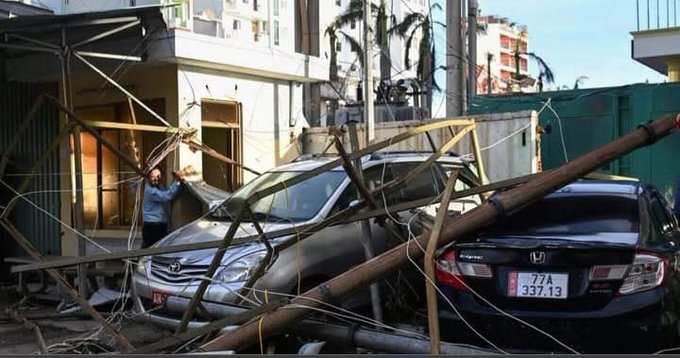
One of the Strongest Storms to Hit Vietnam Brings Torrential Rains, Floods, and Power Outages
Typhoon Kalmaegi tore through central Vietnam late Thursday, leaving widespread damage after cutting a deadly path through the Philippines, where nearly 200 people lost their lives. The storm, one of the most powerful in recent years, unleashed violent winds, torrential rainfall, and catastrophic flooding across Southeast Asia.
Vietnam Faces Widespread Destruction
Late Thursday night, Kalmaegi made landfall along Vietnam’s central coast, bringing sustained winds of up to 125 mph before gradually weakening as it moved inland. The storm struck regions already drenched from weeks of record rainfall, compounding the scale of destruction.
By Friday morning, reports from across the affected provinces described collapsed homes, roofs torn away, uprooted trees, and massive power outages impacting more than one million residents.
At least five people were killed and seven injured, while three others remain missing after being swept out to sea near Ly Son island in Quang Ngai province.
In Dak Lak province, coastal communities were hit by severe flooding, recording nearly 354 millimeters (1 foot) of rain within just six hours. More than 500,000 people were evacuated, many of them by boat, as authorities worked through the night to move residents to safety.

Flood-Hit Regions Struggle to Recover
The typhoon’s arrival comes just days after Vietnam suffered from devastating floods that submerged ancient towns and cultural sites, including Hoi An and the imperial city of Hue.
Those earlier floods killed more than a dozen people, damaged 116,000 homes, and destroyed 5,000 hectares of crops, deepening the country’s humanitarian crisis.
Officials warned that while Kalmaegi continues to weaken, heavy rains and flash floods could persist into the weekend, raising the risk of landslides across mountainous areas in central Vietnam.
Philippines: Nearly 200 Dead, Thousands Displaced
Before striking Vietnam, Typhoon Kalmaegi — known locally as Tino — devastated the Philippines on Tuesday, unleashing record rainfall and storm surges that reduced entire neighborhoods to rubble.
At least 188 people were confirmed dead, with the majority of casualties reported in Cebu province, a major tourist hub.
More than 135 people remain missing, while 96 were injured, according to local disaster officials.
Drone footage revealed catastrophic flooding across Cebu City and Talisay, where roads turned into raging rivers, homes were submerged, and vehicles overturned. In some areas, the storm dumped a month’s worth of rain in just 24 hours.
Rescue teams worked around the clock, wading through waist-deep water to evacuate stranded residents. Survivors described the disaster as unlike anything they had experienced before.
“We don’t have any home anymore. We weren’t able to salvage anything,” said Mely Saberon, 52, from Talisay. “We’ve experienced many typhoons, but this one was different. Our homes are gone.”
Another survivor in Cebu City said floodwaters rushed in so quickly that there was no time to gather belongings.
Climate Crisis Intensifies Storm Severity
Meteorologists and scientists have repeatedly warned that the human-driven climate crisis is amplifying the intensity and frequency of tropical storms across the Asia-Pacific region.
Typhoon Kalmaegi, one of the strongest on record to hit Vietnam, underscores how rising ocean temperatures and shifting weather patterns are contributing to increasingly destructive weather systems, particularly affecting vulnerable communities in the Global South.
Next Threat: Typhoon Fung-Wong Approaches
Even as recovery efforts continue, forecasters have warned that another storm — Tropical Storm Fung-Wong (locally called Uwan) — has intensified and could reach Category 3 or 4 strength over the weekend. The system threatens to bring further flooding and destruction to the northern parts of the Philippines’ Luzon island, which remain waterlogged from Kalmaegi’s impact.
What Lies Ahead
Kalmaegi is expected to continue weakening as it tracks inland through northern Cambodia, Laos, and eastern Thailand. However, heavy rainfall and strong winds remain a threat, with authorities warning of possible flash floods and landslides over the coming days.
Both Vietnam and the Philippines are now facing massive humanitarian and recovery challenges, with hundreds of thousands displaced, homes destroyed, and essential infrastructure crippled.