New Delhi : “Give me an efficient 2-day plan to cover all things to see in Bangalore”
“My pet has a 106 degree fever. What does it mean?”
“Split this bill among 5 people and calculate how much each of us owe”
It may not have been the intention of developers of generative artificial intelligence, but going by these prompts it has, over the years, turned into an intrinsic part of a person’s daily life.

Somewhere along the line, “just Google it” started turning into “just ChatGPT (or insert the name of your favourite Gen AI application here) it.”
But what is its cost?
The fact that AI, and more specifically, the data centres that support AI, consume a mammoth amount of power and water is very well known. It is a point of contention and discussion in power corridors – both in governments, Silicon Valley and closer home, in India’s private tech ecosystem.
And in India, where still more than half of the country is agrarian facing, and naturally, is dependent on the vagaries and whims of climate (change) especially for water, it is a problem that needs solving. And fast
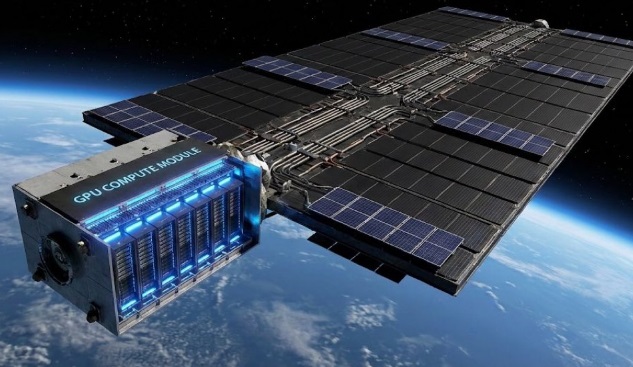
Now, in a bid to avoid these complications – many geographies such as the USA, Europe and tech honchos such as Elon Musk and others have begun talking about putting data centers in space. Following in close heels, is many Indian tech big wigs and space startups.
Before we get into who these players are and what they are doing, it’s necessary to understand what space/orbital data centres are aiming to solve, and how they will work.
The basics
The science behind space data centres is not as sci-fi as it may seem.
The Earth’s Low Earth Orbit (LEO) is located at altitudes of 400-1,400 km above its surface. Satellites (with GPUs) in this orbit (will) travel around the planet every 90-120 km, giving access to almost-continuous solar exposure – ergo round-the-clock, cheap solar power.
Decoding Space
Now traditional data centres need huge quantities of clean water for cooling graphics processing units (GPUs). Temperatures in space, on the other hand, range anywhere between 120 degrees Celsius to -250 degrees Celsius depending on whether the satellite is exposed to the Sun or in a shadow area,
So, if the spacecraft leverages this extreme environment, it can completely bypass the need for water infrastructure.
However, because space is a vacuum, traditional convection-based cooling — like using fans to blow air — is impossible. Instead, space data centres must rely on conductive heat pipes and giant radiative panels, several experts told Moneycontrol.
“The vision for orbital data centers is not hyperscale facilities in space. Rather, it’s a modular, networked layer of compute satellites designed for workloads where orbit provides structural advantages, such as near-continuous solar exposure (with a low orbit close to 1,400 km), a passive thermal environment, proximity to space-generated data, and/or geopolitical resilience,” according to a paper by consulting firm Arthur D Little (ADL).
Who is doing what
The commercial conversation around orbital data centres was ignited by SpaceX founder and X owner Elon Musk, who termed space-based AI infrastructure as an absolute “no-brainer” because “it’s always sunny in space.”
Musk’s aggressive push culminated in a massive SpaceX FCC application which proposed a constellation of up to 1 million satellite data centers for heavy AI processing. Post that several geographies, and tech players have proposed similar measures.
In India, Bengaluru-based spacetech startup Pixxel and AI startup Sarvam AI announced the 200 kg-class Pathfinder satellite —scheduled for launch as early as Q4 2026 — which will host data-centre-grade GPUs to run Indian-governed language models and process hyperspectral imagery directly in Low Earth Orbit (LEO).
Simultaneously, Chennai-based launch provider Agnikul Cosmos has teamed up with cloud infrastructure firm NeevCloud to deploy an orbital AI inference network, with commercial operations targeted for 2027.
Additionally, Hyderabad-based TakeMe2Space has announced that they will eventually deploy a 50 kw orbital data centre as well.
But while the announcements may sound futuristic, the push toward orbital compute is increasingly being driven by hard economics and geopolitics rather than science fiction.
How Indian startups are planning deployment
Each Indian startup is approaching the opportunity differently.
Pixxel’s partnership with Sarvam AI is aimed at proving that sovereign AI workloads can run directly in orbit.
The Pathfinder satellite will initially host only a small number of GPUs – Blackwell or H200 class GPU –, but the larger goal is technological validation, Awais Ahmed, CEO and co founder of Pixxel said.
Ahmed said most of the real testing will begin only after launch. “Once it’s in orbit, that’s the real test,” he said.
Agnikul Cosmos, meanwhile, is taking a more infrastructure-led approach.
Rather than building the data centre itself, the company wants to offer its launch systems and patented upper-stage platforms as orbital hosting infrastructure.
Typically, rocket upper stages become debris after satellite deployment.
Agnikul wants to convert those upper stages into long-duration orbital platforms capable of hosting compute payloads.
“You can think of us as the real-estate provider for orbital data centres,” Srinath Ravichandran, Agnikul’s CEO and co-founder told Moneycontrol.
The company eventually wants to support modular compute systems in the 10-100 kilowatt range, scaling toward one megawatt over time.
TakeMe2Space has perhaps laid out the most aggressive roadmap.
The startup plans to relaunch a 120-watt experimental satellite later this year after losing an earlier mission aboard a failed launch in January 2026.
That first system will carry around 40 terabytes of storage and act as a single-node orbital compute platform.
The next phase — targeted for 2027-28 — involves a five-kilowatt constellation architecture with optical inter-satellite connectivity.
By 2029, the company hopes to deploy a 50-kilowatt, 2.5-ton satellite carrying 400 petabytes of storage. For this, the startup is looking to raise a $55 million following a $5-million seed round in January 2o26.
TakeMe2Space founder Ronak Kumar Samantray said the company is targeting sectors such as BFSI and defence, and already has customers with signed letters of intent.
NeevCloud, on the other hand, is focusing more narrowly on inference infrastructure for specialised workloads.
The company plans to begin testing chips in orbit this year before scaling commercial deployments in 2027.
Orbital Data Centres AI next frontier
Not your regular cloud server
Industry executives are careful to point out that orbital data centres are not simply “AWS in space.”
At least not yet.
Most Indian companies are initially targeting specialised workloads rather than general-purpose cloud computing.
NeevCloud founder Narendra Sen said the company is focusing on applications such as defence, maritime operations, autonomous systems, healthcare and agritech.
“These are not general-purpose workloads,” he said. “These are mission-critical applications.” The advantage, according to experts, is latency and sovereign control.
Because LEO satellites orbit only a few hundred kilometres above Earth, inference workloads can theoretically be processed and returned within milliseconds.
Sen said NeevCloud is initially targeting around 10,000 concurrent inference connections from its orbital infrastructure.
Similarly, TakeMe2Space is focusing on in-orbit inferencing and secure cold storage of critical data.
Pixxel, meanwhile, sees another use case entirely: processing space-generated data directly in orbit.
Currently, earth observation satellites (the kind of satellites that Pixxel deploy) generate enormous quantities of imagery and sensor data. Much of that data still needs to be downloaded to ground stations before processing.
Orbital compute could change that equation.
“You can process imaging data, missile tracking data or weather intelligence directly in orbit and only send the final insights down,” Pixxel’s Ahmed said.
The downlink problem
Yet for all the excitement, the technology stack remains riddled with unresolved challenges. The biggest among them: getting data back to Earth.
Rahul Seth, founder and general partner at Industrial47, described the problem bluntly.
“Launching is one part. Making the hardware function reliably in space is another. But the third challenge is downlink,” he said.
Satellites do not maintain continuous connectivity with a single point on Earth. They move constantly, meaning communication windows can be short and intermittent, he explained.
“You may only get visibility of about seven-and-a-half minutes before the satellite moves,” said Manu Iyer, managing partner at Bluehill VC. “Getting this done in real time is the biggest challenge.”
This is where optical inter-satellite links — another technology heavily championed by SpaceX through Starlink — enter the picture.
Instead of immediately transmitting data to Earth, satellites can communicate with one another in orbit using laser or optical links.
Seth said these technologies are rapidly evolving and may become foundational for future orbital compute ecosystems.
“Optical interlinks are a core piece of technology,” he said. “That’s where there’s real IP and R&D opportunity.”
Industry executives also expect entirely new business models to emerge around orbital compute marketplaces — platforms where satellite operators could buy and sell storage or compute capacity from one another.
The GPU challenge
Then comes another problem: GPUs themselves were never designed for space.
Traditional data-centre GPUs generate enormous amounts of heat. But in orbit, these chips must also survive radiation exposure for years.
That creates a difficult engineering tradeoff.
“You need to radiation-harden the GPUs, but the act of hardening them can weaken thermal handling,” said Agnikul’s Ravichandran.
“There’s a sweet spot that has to be figured out.”
Today, most companies are adapting terrestrial GPUs rather than using chips purpose-built for orbit.
Pixxel said its Pathfinder satellite will carry high-performance data-centre-grade GPUs rather than low-power edge-computing hardware typically used in satellites.
Ahmed drew a distinction between edge AI systems and what his company is attempting.
“Edge computing is very different from proper GPU-grade data-centre computing,” he said. “What we are putting up are Blackwell or H200-class GPUs.”
Those chips consume significantly more power and generate significantly more heat.
But they also unlock the possibility of running advanced AI inference workloads directly in orbit.
Still, executives admit that no one has yet solved the “perfect orbital GPU” problem.
“There isn’t a space-native GPU yet,” Ravichandran said. “That will probably require a new generation of hardware.”
The Elon Musk and Starship factor
No conversation around orbital data centres today is complete without Elon Musk and SpaceX.
Across the global space industry, executives and investors repeatedly point to one thing that changed the conversation: reusable rockets — and specifically Starship.
“A lot of this became inevitable once Elon started going deep into it,” said Awais Ahmed, co-founder and CEO of Pixxel. “Due to decreasing launch costs and increasing restrictions around putting data centres together on ground, orbital data centres are going to happen.”
Ahmed said that while Pixxel itself does not plan to compete with SpaceX in building giant orbital constellations, the company wants to position itself as an infrastructure enabler for governments and enterprises that may eventually require sovereign compute in orbit.
Several executives interviewed by Moneycontrol said Starship’s eventual promise of dramatically lowering launch costs could fundamentally alter the economics of compute.
If fully reusable rockets like Starship can bring launch costs closer to the much-discussed $200-$500 per kilogram threshold, the calculus changes significantly.
“Starship is probably the only launch system that can get even close to matching terrestrial compute economics because of its massive carrying capacity and reusability,” Ahmed said.
The sheer scale matters. A single Starship mission could potentially deploy hundreds of compute satellites together, something small launch vehicles cannot economically achieve.
That is also why many industry executives believe the first phase of orbital data centres may remain dependent on SpaceX infrastructure — at least globally.
Srinath Ravichandran, co-founder and CEO of Agnikul Cosmos, called this one of the biggest strategic bottlenecks facing the ecosystem.
“Today the bottleneck is definitely launches. Given that SpaceX is the only regularly flying rocket today, anyone who wants to build a data centre will have to go to SpaceX,” he said.
“And it almost feels like you’re going to your competitor as a supplier because they themselves are doing it.”
Scepticism remains
Not everyone is convinced the economics will work.
Investors tracking the sector say the hype cycle is currently running ahead of technical reality.
“Everyone wants to get into space data centres because Elon Musk is creating so much noise,” said Bluehill VC’s Manu Iyer.
“But many are making announcements first and thinking about feasibility later.”
Iyer argued that orbital data centres are fundamentally a satellite and communications challenge rather than merely a launch problem.
The key bottlenecks, according to him, remain power generation, downlink bandwidth and inter-satellite communication.
Still, he believes India has a meaningful opportunity because of its strong engineering talent and growing spacetech ecosystem.
Others also caution that orbital data centres are unlikely to replace terrestrial hyperscalers anytime soon.
Industrial47’s Seth said the more realistic near-term opportunity lies in sovereign infrastructure and defence applications rather than replacing traditional cloud providers.
“My personal view is that this is not a replacement for AWS today,” he said.
But for countries increasingly worried about strategic autonomy in AI infrastructure, the attraction is becoming hard to ignore.
“You may eventually reach a point where countries say: regardless of cost, we need our own sovereign compute infrastructure in space,” said Pixxel’s Ahmed.
The bigger picture
In many ways, orbital data centres sit at the intersection of three global races happening simultaneously: AI supremacy, sovereign technology infrastructure and the commercialisation of space.
And India, unusually, now finds itself participating in all three.
Launch providers want new payload demand. AI companies want compute. Governments want sovereign infrastructure. Satellite startups want in-orbit processing. Venture capital wants the next frontier.
For now, orbital data centres remain experimental.
The economics are uncertain. The engineering remains unsolved. Launch costs are still high. Radiation hardening is incomplete. Downlink infrastructure is immature.
But then again, reusable rockets once sounded impossible too.
As Skyroot Aerospace co-founder Pawan Kumar Chandana put it, the industry increasingly believes that “the lowest cost of compute will eventually be in space.”
Whether that future arrives in five years or fifteen remains an open question. But the race to build it has already begun.