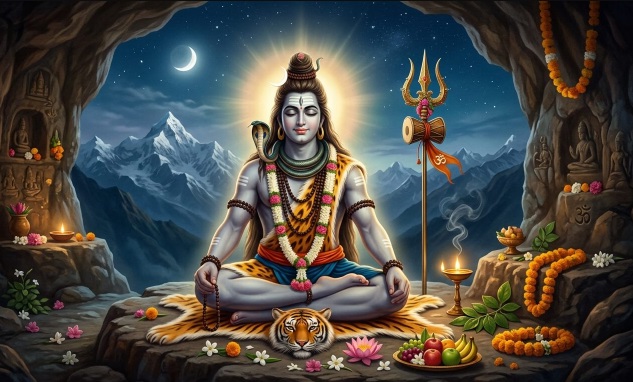
NEW DELHI : Shiv Tandav Stotram is one of the most powerful and sacred hymns in Hinduism. It was composed by demon king Ravana, who was an ardent devotee of Lord Shiva. Shiva Tandav Stotram describes the cosmic dance (Tandav) of Lord Shiva, which is believed to create, sustain, and destroy the universe. This 17-verse hymn, written in Sanskrit, when recited with extreme devotion and sincerity, has a significant impact on the devotee.
The Story Behind Its Origin
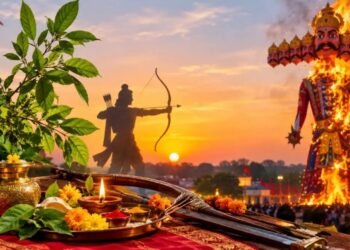
According to Hindu mythology, Ravana once tried to lift Kailash in his arrogance and devotion. To stop him from doing this, Lord Shiva pressed his toe down and crushed the fingers of Ravana. Instead of crying out in pain, Ravana started singing a hymn which came to be known as the popular Shiva Tandav Stotram.
By hearing him sing so beautifully and being pleased with his devotion, Lord Shiva blessed Ravana and released him. He also gifted him with a divine sword- the Chandrahas.
Shiv Tandav Stotram Lyrics With Meaning In English
Verse 1

Jatatavee gala jjala pravaha pavitha sthale
Gale avalambya lambitam bhujangatunga malikam
Dama ddama dama ddama ninnadava damarvayam
Chakara chanda tandavam tanotu nah shivah shivam
Meaning: From the dense forest of His matted hair flows the sacred river (Ganga), purifying all in its path. Around His neck hangs a garland of great serpents. With the thundering sounds of “dama dama” from His damaru drum, He performs the fierce Tandav dance. May that Shiva bestow prosperity upon us.
Verse 2
Jata kata hasam bhrama bhramani limpanir jhari
Vilola veechi vallari viraja mana moordhani
Dhaga dhaga dhaga jjvala lalata patta pavake
Kishora chandra shekhare ratih pratikshanam mama
Meaning: The river Ganga cascades and swirls through His matted hair, her waves dancing and shining upon His head. His forehead blazes with a fire that burns “dhaga dhaga.” May my love and devotion grow every moment for Lord Shiva, who wears the crescent moon on His head.
Verse 3
Dhara dharendra nandini vilasa bandhu bandhura
Sphurat diganta santati pramodamana manase
Krupakataksha dhorani niruddha durdharapadi
Kvachi digambare mano vinodamethu vastuni
Meaning: He who is the companion in the playful sport of the daughter of the mountain king (Parvati), whose mind rejoices as His glory spreads across all directions, whose stream of compassionate glances wards off all insurmountable calamities — may that Lord Shiva, who is clad in the directions (sky-clad), be the source of delight for my mind.
Verse 4
Jata bhujanga pingala sphurat phana mani prabha
Kadamba kumkuma drava pralipta digvadhu mukhe
Madandha sindhura sphurat tvaguttariya medure
Mano vinodamadbhutam bibhartu bhoota bharthari
Meaning: The yellowish serpent coiled in His matted hair radiates the brilliance of its hood-gem, painting the faces of the directions’ brides with the hue of kadamba and kumkuma. He wears the hide of a mighty intoxicated elephant as His upper garment. May the Lord of all beings (Bhoota Bharthari) hold wondrous delight in my mind.
Verse 5
Sahasra lochana prabhritya shesha lekha shekhara
Prasoona dhooli dhorani vidhu saranghri peethabhoo
Bhujangaraja malaya nibaddha jaata jootaka
Shriyai chiraya jayatam chakora bandhu shekharah
Meaning: The dust from the flowers offered at His feet by the thousand-eyed Indra and other celestial beings adorns the ground beneath His feet. His matted hair is bound by the king of serpents. May Lord Shiva, who wears the crescent moon (friend of the chakora bird) on His crest, grant us lasting prosperity and auspiciousness.
Verse 6
Lalata chatvarajvala dhananjaya sphulingabha
Nipeetha pancha sayakam namannilimpa nayakam
Sudha mayookha lekhaya virajamana shekharam
Maha kapali sampade shirojatala masthu nah
Meaning: From the fire blazing on the open courtyard of His forehead, sparks flew that burnt Kamadeva (the five-arrowed god of love) to ashes. The chiefs of the gods bow before Him. His crest shines gloriously with the crescent moon’s nectarous rays. May the matted locks of the great Lord of the cremation ground bestow wealth upon us.
Verse 7
Karala bhala pattika dhagad dhagad dhagajjvala
Ddhananjayahuti kruta prachanda pancha sayake
Dhara dharendra nandini kuchagra chitra patraka
Prakalpanaikashilpini trilochane ratirmama
Meaning: His fierce forehead blazes with fiery flames that burned the god of love in their sacrificial fire. He is the supreme artist who paints beautiful ornamental designs on the bosom of the mountain king’s daughter (Parvati). May my devotion rest in that three-eyed Lord Shiva.
Verse 8
Naveena megha mandali niruddha durdharasphurat
Kuhu nisheethinee tamah prabandha baddha kandhara
Nilimpa nirjhari dhara stanotu krutti sundarah
Kalatva malpaneshwara mahasya bhoota bharthari
Meaning: The thick darkness of the new moon night, intensified by banks of dense clouds, matches the darkness of His neck (Neelakantha — the one who holds poison in His throat). May the beautiful Lord who wears elephant hide, who carries the celestial Ganga, the great Lord of all beings, bestow His blessings upon us and end the cycle of death.
Verse 9
Praphulla neela pankaja prapancha kalimachata
Vdambi kanthakandali raruchi prabandha kandharam
Smarachchidam purachchhidam bhavachchidam makhachchidam
Gajachchidam andhakachidam tamantakachchidam bhaje
Meaning: His neck possesses a lustre that mocks the beauty of fully bloomed blue lotuses. I worship Lord Shiva — the destroyer of Kamadeva (Smara), the destroyer of Tripura, the destroyer of the cycle of birth and death, the destroyer of the sacrificial ritual (of Daksha), the destroyer of the elephant demon (Gajasura), the destroyer of Andhaka, and the destroyer of Yama (the god of death).
Verse 10
Akharva sarva mangala kalakadamba manjari
Rasa pravaha madhuri vijrumbhana madhuvratam
Smarantakam purantakam bhavantakam makhandakam
Gajandakandhakandakam tamandakandakam bhaje
Meaning: Around Him swarm bees intoxicated by the sweet nectar flowing from the bouquets of kadamba flowers that embody all auspiciousness. I worship that Lord Shiva — the ender of Kamadeva, the ender of Tripura, the ender of worldly existence, the spoiler of Daksha’s sacrifice, the one who punished the elephant demon, and the one who punished Andhaka.
Verse 11
Jayatvadabhravibhrama bhramadbhujangamasafur
Dhigdhigdhi nirgamatkarala bhaal havyavaat
Dhimid dhimid dhimidhvanan mrudanga tunga mangala
Dhvani krama pravartita prachanda tandavah shivah
Meaning: The serpents wrapped around His body sway and swing as He whirls in dance. The blazing fire on His fierce forehead spreads its flames in every direction with a “dhig dhig” sound. Shiva performs the mighty Tandav dance, keeping rhythm to the “dhimid dhimid” auspicious beats of the mridanga drum.
Verse 12
Drushadvichitratalpayor bhujanga mauktikasrajor
Garishtharatnaloshthayoh suhrudvipakshapakshayoh
Trunara vinda chakshushoh prajamahi mahendrayoh
Sama pravartayanmanah kadha sadashivam bhajeth
Meaning: When will I worship Lord Sadashiva with a mind that treats alike a bed of stone and a colourful bed, a garland of snakes and a garland of pearls, the most precious gem and a lump of dirt, a friend and a foe, a blade of grass and a lotus-eyed beauty, an ordinary man and a great emperor — seeing all with perfect equanimity?
Verse 13
Kada nilimpa nirjhari nikunjako tare vasan
Vimuktadurmatih sada shirah sthamanjalim vahan
Vimuktalolalochano lalamabhala lagnakah
Shiveti mantra mucharan kadha sukhee bhavamyaham
Meaning: When shall I live in a cave near the Ganga, free from all evil thoughts, my hands always joined in reverence above my head, my eyes free from worldly attachments and fixed on the forehead of Lord Shiva, chanting “Shiva, Shiva” — when shall I attain such bliss and happiness?
Verse 14
Imam hi nityameva mukta muttamottamam stavam
Pathansmaranbruvannaro vishuddhimeti santatam
Hare gurau subhaktimashulabhyavashlatam
Iyam yamaasu nityameva muktamuttamam stuti
Meaning: Whoever reads, remembers, and recites this supreme and eternal hymn regularly attains purity and devotion to Lord Shiva, the Supreme Guru. This hymn is truly the highest and most liberating prayer.
Verse 15
Poojavasana samaye dashavanakthena yah
Imam patheth stotram shivasannidhau
Praroya tham sarvamanorathah
Praapnoti vidyamm shivena santatam
Meaning: Whoever recites this stotram at the end of worship in the presence of Lord Shiva, just as the ten-headed Ravana did, shall have all their desires fulfilled and shall attain knowledge and the eternal grace of Lord Shiva.
Benefits Of Chanting Shiv Tandav Stotram
- Invokes the blessings of Lord Shiva
- Removes fear and protects from negative energy
- Helps to purify the mind
- Promotes spiritual growth
- Builds confidence, courage, and willpower
- Helps in overcoming challenges
- shivling sitting
Thus, chanting Shiv Tandav Stotram, especially during Sawan, is beneficial for devotees as it invokes the divine blessings of Lord Shiva.