New Delhi: Fantasy mythology adventures were a staple of filmmaker Kodi Ramakrishna’s filmography in the 1990s and early 2000s. From Ammoru to Devi Putrudu, his films blended mythology with fantasy in a way that connected with audiences. But not every film in this genre manages to leave the same impact. Abhishek Nama’s Telugu film Nagabandham is the latest attempt at telling a mythology-inspired action adventure, but it struggles to rise above familiar tropes.
The film leans heavily into themes of faith and destiny, with its lead characters portrayed almost as divine protectors of their community. It also reflects a modern socio-political outlook that associates an entire region with a single faith. Right from the opening sequence, Nagabandham explores mankind’s endless pursuit of immortality and absolute power. Unfortunately, the story offers very few surprises and follows a predictable path throughout.
Nagabandham: The story
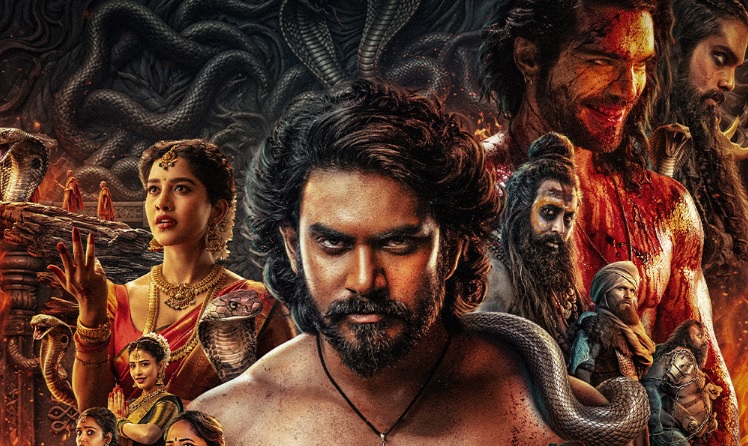
The story revolves around the mythical Brahma Kamalam, a rare golden flower believed to be kept inside an ancient temple dedicated to Lord Ranganatha in Srirangapuram. An American archaeologist named Tesla discovers an ancient manuscript called Nagabandham, which is said to contain clues to a hidden treasure buried beneath India. Believing it could change the country’s future, he hands the manuscript over to Pratap (Jagapathi Babu), the head of India’s Archaeology Department.
Before the mystery can unfold, Ali (Rishabh Sawhney) murders Tesla and his wife, played by Nabha Natesh, and steals the manuscript. His mission is to deliver it to Bairagi (Garuda Ram), a powerful figure trapped inside a cave for centuries, who wishes to escape and gain complete control over the world.

Meanwhile, in Srirangapatnam, Rudra (Virat Karrna) agrees to guide an expedition to Bhairavakona, where the sacred Brahma Kamalam is believed to be hidden. After a life-changing incident, Rudra is rescued by Parvati (Nabha Natesh). Soon, Ali’s gang kills Rudra’s family, and he discovers that Parvati is somehow connected to the same group. But who is Parvati really? Can Rudra protect the sacred flower? And can a centuries-old rivalry between Rudra and Ali finally come to an end? The answers form the rest of the story.
Nagabandham: Performances
Virat Karrna takes on a double role, playing both present-day villager Rudra and a 17th-century Naga Sadhu. He has clearly worked hard on his physique, which suits the historical character well. While he looks convincing as the Naga Sadhu, his performance as Rudra lacks the charisma expected from a leading man.
Nabha Natesh also appears in dual roles and finally gets enough scope to showcase her acting abilities. Rishabh Sawhney impresses the most, portraying both Ali and Afghan invader Ahmad Shah Abdali with confidence. He gets ample screen time and emerges as a convincing and powerful villain.
Jagapathi Babu delivers another dependable performance, while Murali Sharma and Mahesh Manjrekar are effective as temple priests. Sonia Singh performs well in an emotional role as Rudra’s sister. Aniket Koyya has little to do. Garuda Ram’s appearance is decent, while Daksha Nagarkar and Aishwarya Menon leave an impression despite limited screen time. Anasuya Bharadwaj also makes her presence felt in a brief but impactful role.
Nagabandham: Technical aspects and music
The biggest strength of Nagabandham lies in its visuals. Cinematographer Soundar Rajan creates striking frames through impressive lighting, compositions and camera angles. The visual effects are largely convincing, although a few sequences appear AI-generated.
The soundtrack is pleasant, but stronger songs could have elevated the film’s emotional moments. The background score does its job without standing out.
Nagabandham: Editing and cinematography
Editing is one of the film’s weakest areas. The action sequences are stretched far longer than necessary, making the film feel repetitive and exhausting. The dialogues lack impact, while the screenplay never fully finds its rhythm.
The production design deserves appreciation. Despite being mounted on a relatively modest budget, the sets, especially the Ranganatha Swamy temple, look grand and authentic. Soundar Rajan’s cinematography adds scale to the narrative, although the excessive use of slow-motion shots and VFX occasionally becomes distracting.
The songs composed by Junaid Kumar and ABHE in the first half are enjoyable, but the background score can feel overpowering at times. The sequences centred around Lord Shiva are visually effective and create a strong impact.
Nagabandham: What works and what doesn’t
Despite its spectacular visuals, Nagabandham is ultimately let down by its storytelling. The film runs for nearly 3 hours and 15 minutes, and trimming 20 to 30 minutes would have made it far more engaging.
From a technical standpoint, there is little to complain about. The visuals, graphics and production values are all impressive. However, they cannot compensate for a weak screenplay.
Making a grand mythological spectacle is not the problem. The problem begins when the fundamentals of storytelling are overlooked. Recent years have seen a rise in films inspired by Hindu mythology, but a compelling theme alone is never enough. A film still needs an engaging story, well-written characters and an emotionally satisfying screenplay. Nagabandham falls short on all three counts.
The film also lacks emotional depth, making it difficult to connect with its central characters. As a result, even its most visually impressive moments fail to leave a lasting impact.
Nagabandham: Final verdict
Overall, Nagabandham is an ambitious mythological adventure mounted on a grand scale. It delivers stunning visuals, lavish sets and technically polished filmmaking. However, the weak story, uneven screenplay, overlong action scenes and lack of originality prevent it from becoming a memorable experience.
If you enjoy South Indian mythological adventures, the film may still be worth a watch on the big screen for its visual spectacle alone. But if you are looking for a gripping story with emotional depth, Nagabandham is likely to leave you disappointed.