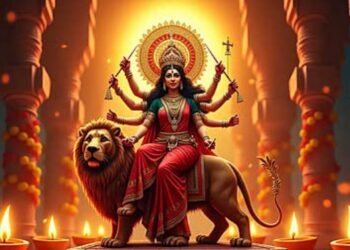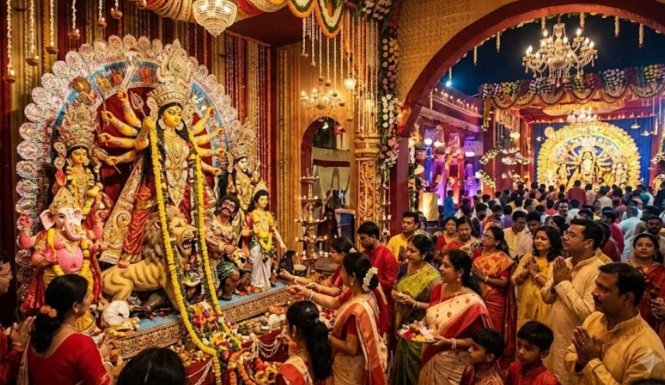
New Delhi: This year, the Green Glen Layout Cultural Association (GGLCA) in Bengaluru’s Bellandur is celebrating Durga Puja with a message of peace, forgiveness and communal harmony.
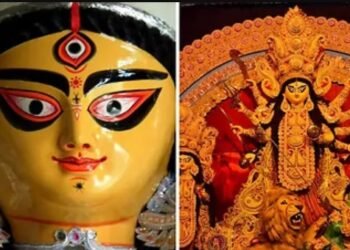
Moving away from the traditional depiction of Goddess Durga slaying the buffalo demon Mahishasura, the current theme — Mrinmoyee Abhaya — depicts the demon surrendering to the Goddess and seeking forgiveness, which she has already granted.
GGLCA president Subhrangsu Basu told ETV Bharat that the association wanted to create a welcoming, homely atmosphere where people could celebrate together irrespective of their religious beliefs.
“This year, our theme is Mrinmoyee Abhaya, and the idol conveys a message of forgiveness and peace. Instead of showing Mahishasura fighting the Goddess, we have depicted him seeking forgiveness, which Ma Durga has already granted,” Basu said, adding that the aim was to spread a message of harmony at a time when several parts of the world are witnessing wars and violence.

Former president Indraneel Dutta said Durga Puja celebrates the homecoming of the deity, a tradition deeply cherished by Bengalis across the world. “Durga Puja is an occasion that brings people together. Our celebration is not limited to Bengalis. People from different communities participate, and we want everyone to feel welcome. Through Ma Durga’s homecoming, we hope to spread love, peace and brotherhood,” he added.
Earth, Fearlessness and Non-Violence
Tathagata Sengupta, general secretary of the organising committee, explained that Mrinmoyee Abhaya combines two ideas: the Earth from which the Goddess takes form and her fearless, peaceful presence.
“Mrinmoyee represents the Earth, the basic element through which the Goddess takes shape, which influences our decorations. Abhaya represents fearlessness. We want to convey that courage does not always mean fighting or using violence. In today’s world, fearlessness through peace and non-violence is equally important,” he added.
A Daughter’s Homecoming
Payel Sengupta, a devotee, explained that Durga Puja has a distinct cultural significance compared with Navaratri, as it celebrates the Goddess’ return to Earth as a daughter. The main festivities span Shashti, Saptami, Ashtami, Navami and Dussehra.
“Durga Puja is like welcoming a daughter home. Shashti is associated with mothers praying for their children’s well-being, while on Saptami, nine forms of the Goddess are worshipped through the Nabapatrika, also known as Kala Bou, which includes a banana plant,” she said.
Sen explained that Sandhi Puja, performed at the transition from Ashtami to Navami, is considered especially auspicious and commemorates the Goddess’s victory over Mahishasura. The celebrations culminate in Dussehra, with rituals such as Sindoor Khela, when women apply vermilion to one another and pray for happiness, well-being and peace.
Kolkata Flavours and Community Service
Food has also become an important part of the celebrations. Hiya Sinha, associated with Hiyar Majhe Kolkata, said the venture, started in 2014, had been bringing authentic Kolkata flavours to Bengaluru during Durga Puja stalls for five years. “Food has no geographical boundaries. People may come from different places, but the love for good food brings everyone together,” she said.