Special Desk
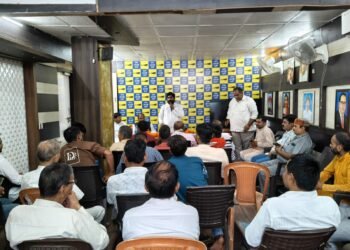
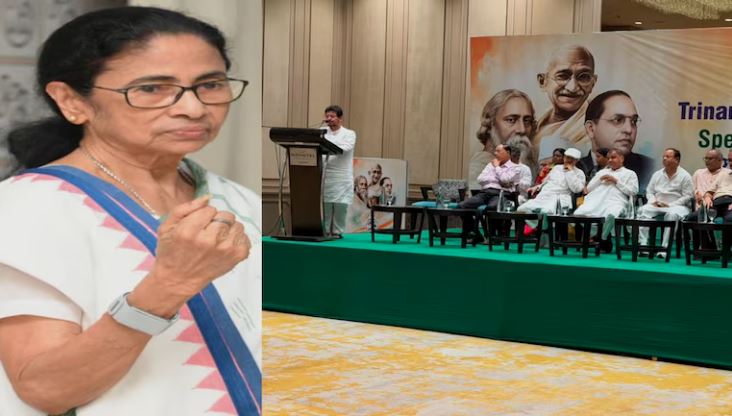
A major and historic development has emerged in West Bengal politics. The Trinamool Congress (TMC), founded in 1998 by Mamata Banerjee, is now going through a serious organizational crisis. Rebel MLAs of the party, in a meeting held in Kolkata, have claimed to remove Mamata Banerjee from the post of party president and declared former minister Arup Roy as the new president. Let’s understand this analysis in detail with Executive Editor Prakash Mehra.
The rebel group also announced that MLAs Sandipan Saha, Javed Khan, and Ritabrata Banerjee have been made general secretaries. Meanwhile, former Kolkata Mayor Firhad Hakim, former minister Arup Biswas, and Rathin Ghosh have been appointed as vice presidents. MLA Akhruzzaman has been declared the new treasurer of the party.
After the meeting, opposition leader Ritabrata Banerjee claimed that “their entire process is in accordance with Election Commission rules and will also be informed to the Commission. Their faction is the ‘real Trinamool Congress’.”

Biggest political challenge for Mamata Banerjee
This development is not just an organizational dispute but is also emerging as a major challenge for Mamata Banerjee’s political future. After TMC’s defeat in the 2026 West Bengal Assembly elections, dissatisfaction within the party had been steadily increasing and has now turned into open rebellion.
The rebel faction claims that “out of 80 TMC MLAs in the Assembly, 65 MLAs are with them. Similarly, out of 28 party MPs in the Lok Sabha, 20 MPs have also left Mamata Banerjee’s side and adopted a separate path.”
These MPs have allegedly joined a new political platform and decided to support the BJP-led central government. If this claim holds politically and legally, it would be considered the biggest setback for Mamata Banerjee so far.
Counterattack by Mamata supporters
Kunal Ghosh, a close leader of Mamata Banerjee and TMC spokesperson, has described the entire episode as a “comedy show.” He says that the Trinamool Congress and Mamata Banerjee are synonymous and the party cannot be imagined without her.
The Mamata camp argues that the TMC constitution is president-centric and that the party president has the final decision-making authority. According to them, Mamata Banerjee remains the legitimate president in the organizational structure and a meeting of a few MLAs cannot change control of the party.
Why is this the biggest blow for Mamata?
Senior journalist and writer Prakash Mehra believes that “this development could become the most serious crisis of Mamata Banerjee’s political life.”
Prakash Mehra says, “In this phase of betrayal in Bengal, the biggest name is Firhad Hakim. This rebel meeting may prove to be the biggest political setback for Mamata Banerjee so far. It was not just a meeting of a few MLAs. It included councillors, MLAs, and leaders with real grassroots influence.”
He further says, “Leaders like Debashish Kumar are not just names. Even today, they have a strong hold over the public and organization. That is why this rebellion is being seen not just as political rhetoric but as a display of organizational strength.”
According to Prakash Mehra, the upcoming Kolkata Municipal Corporation elections will be the real test for both factions. These elections will reveal whether grassroots workers and voters stand with Mamata Banerjee or with the rebel leaders.
Case reaches the court
The ongoing power struggle within TMC has now reached the judiciary. The Mamata Banerjee faction has filed a petition in the Calcutta High Court challenging the appointment of Ritabrata Banerjee as Leader of the Opposition in the Assembly. The Mamata camp says they had nominated Shovondeb Chattopadhyay as the Leader of Opposition, but the majority in the Assembly supported Ritabrata Banerjee. The High Court has not granted any interim relief to the Mamata faction for now, but affidavits have been sought from all parties.
Can the anti-defection law help Mamata?
Abhishek Banerjee, considered Mamata Banerjee’s political heir, met the Lok Sabha Speaker seeking disqualification of MPs who left the party. His argument is that under the Tenth Schedule of the Constitution, voluntary resignation from a party by an MP or MLA is grounds for disqualification. He says joining another party or forming a separate parliamentary group also counts as defection. However, in such cases, the final decision lies with the Speaker or Chairman, and there is no fixed time limit for a decision in the law.
Battle over election symbol will also be crucial
One of the biggest challenges before Mamata Banerjee is retaining control over the party’s election symbol and name. In recent years of Indian politics, cases like Shiv Sena and the Nationalist Congress Party (NCP) have shown that the Election Commission decides based on the majority of MLAs and MPs.
In the Shiv Sena dispute, the Eknath Shinde faction got the original party and symbol, while the Uddhav Thackeray faction had to adopt a new name and symbol. Similarly, in the NCP case, the Ajit Pawar faction gained organizational advantage. If the TMC dispute reaches the Election Commission, Mamata Banerjee may also have to fight a long legal battle to retain her party’s symbol and name.
Crisis over bank accounts
Amid the political crisis, the party’s financial resources are also being affected. Reports suggest that debit freezes have been imposed on three TMC bank accounts. These accounts reportedly hold around ₹440 crore. A debit freeze means that money can be deposited into the account, but withdrawals or transactions are not allowed. This step has been taken following internal disputes over financial control within the party.
Three fronts before Mamata Banerjee
Mamata Banerjee now faces three major fronts:
- Maintaining control over the organization
- Legal and Speaker-level battles over defection and legitimacy
- Securing the party name and election symbol before the Election Commission
At present, this battle is being fought simultaneously on four fronts—Assembly, court, Election Commission, and organization. In the coming months, it will be decided who holds the real command of the Trinamool Congress and whether Mamata Banerjee can maintain control over the party she herself built.