NEW DELHI: For 17 years, Royal Challengers Bengaluru ended every IPL season on a familiar note. A team stacked with superstars, some of them all-time greats, somehow could not crack the title-clinching code. No matter how promising a campaign looked, it would invariably end in heartbreak for a franchise whose popularity and fanbase rivalled the Chennai Super Kings and Mumbai Indians, the two most successful teams in the tournament’s history.
Clearly, something was missing.
Chris Gayle. AB de Villiers. Faf du Plessis. Shane Watson. Glenn Maxwell. Mitchell Starc. Jacques Kallis. Virat Kohli. RCB developed a knack for landing marquee names. From the outside, it always seemed they had the ingredients. Yet the title remained elusive. In an era increasingly shaped by social media, RCB also evolved into one of the IPL’s most polarising franchises.
No wonder opponents wanted to beat them and not because they were the team to beat. The great Gautam Gambhir has gone on record admitting that RCB are the team he most desired to beat every time, even in dreams.

Rivalries. Unadulterated aggression. Talented players. A passionate and loyal fanbase. RCB had it all. But not the IPL silverware.
Something was missing. Something had to change.
Virat Kohli, the only constant in RCB since the IPL’s inception in 2008, evolved from an emerging batting prodigy into a global phenomenon, and the franchise’s heartbeat. His name became synonymous with RCB, and naturally, he rose to become their leader. Yet, the title remained elusive.
Kohli came closest to breaking the drought in 2016, perhaps the greatest season of his career. He nearly crossed the 1000-run mark in a single edition and, more importantly, carried RCB to the final. Neither milestone materialised. It was yet another heartbreak- RCB’s third failed attempt to cross the final hurdle.
Then came the seismic shift.
Kohli stepped down as captain. Faf du Plessis took over. Little changed. The ageing Faf was then released. And the franchise, once again, went back to the drawing board.
Instead of turning to another marquee name, or even reverting to their iconic leader, RCB made a bold call. They entrusted leadership to the unheralded Rajat Patidar.
Kohli publicly backed Patidar, whose first association with RCB came in 2021, a brief and unremarkable stint that ended in quick separation.
The following season, RCB brought him back as a replacement player. Patidar responded with a sensational century in the IPL Eliminator. By his third season, he had become a regular fixture in the side.
In his fourth season, he was named captain.
And what followed, as they say, is history.
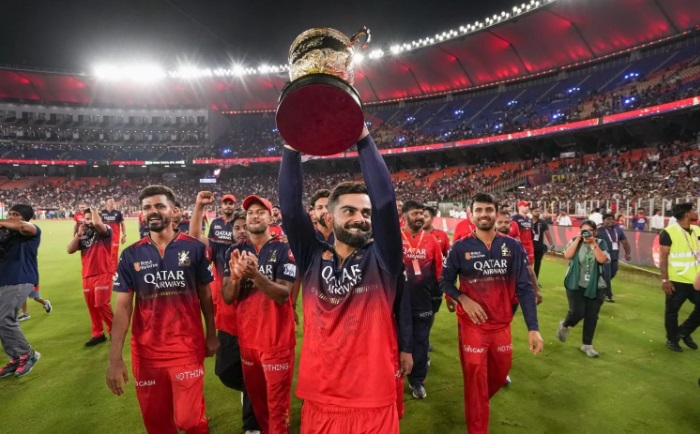
In his first season at the helm, Patidar delivered the silverware as RCB became the IPL champions for the first time in their history.
RCB’s desperation for that moment was laid bare when Kohli broke down in tears, slowly coming to terms with the reality that, after 17 years of trying, he was finally an IPL winner.
IPL 2025 gave them a taste of glory. And now they seem unwilling to let go. Entering IPL 2026 as defending champions, RCB played like one and deservedly kept the crown.
Kohli remained central figure with the bat, but a significant shift had taken place – something he has himself acknowledged. He was no longer burdened by the need to carry the side alone. The squad finally found balance in every department.
Patidar delivered not just as captain but also with the bat, scoring 501 runs at a strike-rate of 192.69. They found a reliable all-round option in Krunal Pandya, capable of changing games with both bat and ball. Their designated finisher, Tim David, delivered when it mattered, highlighted by a blistering 25-ball 70* against CSK earlier in the season.
The bowling attack, too, stood tall.
Bhuvneshwar Kumar, the veteran pacer, rolled back the years and led the attack brilliantly. He finished with 28 wickets – just one short of Purple Cap winner Kagiso Rabada – often striking early in the Powerplay to put opponents on the back foot. No wonder he’s being called the “King of Powerplay”.
Josh Hazlewood may not have been the traditional spearhead this season, but his metronomic accuracy kept batters constantly under pressure and he had 15 wickets to show for ad well. Rasikh Salam Dar emerged as an unsung hero, quietly claiming 19 wickets in 12 games at an average of 21.32, becoming a crucial piece of RCB’s successful title defence.
There was also Venkatesh Iyer, who featured in seven games but made a notable impact – 209 runs at a strike-rate of 186.90, including a tone-setting 32 in the final despite carrying a painful injury.
And then Devdutt Padikkal. After a strong domestic season, he carried his form into the IPL, playing every match and scoring 464 runs at a strike-rate of 168.72. Phil Salt, despite limited appearances due to injury, still contributed 202 runs from six innings at 168.33.
Behind it all, the RCB management – led by team director Mo Bobat, head coach Andy Flower, and mentor Dinesh Karthik – appears to have finally found a winning formula that delivered back-to-back title-winning campaigns.
No title in 17 years. Two titles in 12 months.
RCB are now two-time IPL champions. Some things have surely changed.