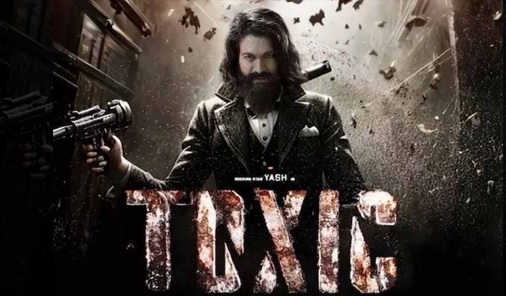
New Delhi : Geetu Mohandas’ Toxic: A Fairy Tale for Grown-Ups plunges straight into a world of violence, opium, betrayal and crime, opening with a chilling line about bastards and belonging. “Jo bastards hote hain unhe ek baat pata hoti hai, Jiski paidaish hain wo na unhe apna naam dega na na unhe usse nikalega.” Yash is clearly the centre of this universe, and whenever he enters an action sequence, Toxic comes alive – though the comparisons to Dhurandhar are hard to ignore. Both films traffic in larger-than-life action, and the resemblance goes further. Yash and Ranveer Singh sport nearly identical long hair and beards, and both have a habit of lighting cigarettes off any open flame when a lighter isn’t handy, and several other similarities that are difficult to overlook.
But once the guns go quiet, Toxic leaves you wondering what exactly the story is trying to tell. Unlike Dhurandhar, which manages to back its spectacle with a more engaging narrative, Toxic struggles to give its larger-than-life action a story with equal impact. The box office response to Dhurandhar only makes the contrast more striking. The screening I attended had more empty seats than filled ones – and by the time the credits rolled, it wasn’t hard to see why.
How’s The Film?
Set against crime-ridden Goa under Portuguese rule, Toxic follows Raya as he rises through the criminal underworld and eventually takes control of a sprawling opium and casino empire. He begins as the right-hand man of powerful kingpin Salvador, played by Darrell D’Silva, before becoming a force of his own. The opium trade sits at the centre of the film, but the narrative keeps veering into sex, violence, family and power – thereby making the plot extremely convoluted.
The trouble is that the first half feels chaotic rather than intriguing. There are plenty of characters, sudden shifts and violent confrontations, but very little that gives the story a clear direction – enough to make you genuinely wonder if you’ve missed a scene or two somewhere. The question of when the actual story will begin keeps creeping in.

Then there are the action sequences, easily the film’s biggest strength. Yash’s introduction, the cemetery revenge sequence and several later combat set-pieces have the scale, ferocity and swagger you’d expect from a star of his stature. The action is so relentless, in fact, that at times it feels like the film is leaning on spectacle to compensate for its loose writing.
Yash’s dialogue, “Meri mother tongue hi violence hai, universal language,” almost sums up the movie.
But the screenplay rarely matches the ambition of the visuals. The writing feels loosely stitched together, the editing doesn’t always help the flow, and several dialogues are likely to leave you uncomfortable. One particularly jarring contradiction is the film’s treatment of relationships and parenthood. A narrative filled with sexual relationships appears to normalise the idea of keeping a mistress, while the notion of a ‘bastard’ son becomes a source of conflict.
Even the line, “Jab tak seh sakti ho tab tak reh sakti ho,” lands awkwardly in a film that repeatedly places its women in subordinate positions.
The female characters feel especially underused. Despite a lineup that includes Kiara Advani, Tara Sutaria, Rukmini Vasanth, Nayanthara and Huma Qureshi, much of the female presence seems designed around glamour rather than character development. Toxic does give its women moments of agency, but they rarely last. Nayanthara, as Raya’s sister Ganga, gets the most substantial arc of the lot, yet even her story eventually circles back to sacrificing herself for him.
The story takes a completely different turn by the time it reaches the climax. What begins as a journey into the drug mafia eventually becomes a story about guilt – one that never feels particularly convincing or emotionally earned.
Performances
Yash is, without question, the film’s biggest asset. As Raya, he’s ruthless, intimidating and almost frighteningly unpredictable – the kind of character who can kill without blinking, and he plays that darkness with total conviction.
There’s a physicality to his performance that makes even the most chaotic scenes watchable. Blink, and you could miss a piece of his action; look away for a second, and he might already have taken down another opponent. He often looks less like a conventional hero and more like a villain you can’t stop watching. That’s where Toxic works best – when Yash simply owns the screen.
The rest of the ensemble gets comparatively little to work with. Kiara Advani, Tara Sutaria, Rukmini Vasanth, Nayanthara and Huma Qureshi are capable performers who do what they can, but the screenplay doesn’t give them enough depth. Too often, they’re reduced to characters who react to men, follow orders or exist as part of Raya’s world rather than building worlds of their own. Rukmini Vasanth gets a slightly more dominant track, and Nayanthara brings real emotional weight as Raya’s sister – but even here, the writing ultimately keeps their choices confined within the hero’s story.
Verdict
Toxic clearly wants to be larger, louder and more ferocious than the average gangster drama, and in parts, it succeeds. The action is slick, the production looks expensive, and Yash’s screen presence is difficult to ignore. There are moments when the film genuinely explodes into life.
But spectacle alone can’t hold together a story this loose. The screenplay is the biggest problem, followed closely by uneven editing, problematic dialogue writing and a directorial hand that doesn’t consistently control the film’s many moving parts. More was expected from Geetu Mohandas, especially given the promise of the premise and the strength of the cast she had to work with.
Compared with the explosive action impact audiences have recently seen in Dhurandhar, Toxic tries hard to deliver the same kind of firepower – but the emotional and narrative foundation isn’t strong enough to match it.
In the end, Toxic is an over-the-top action spectacle rescued by Yash, but weighed down by a screenplay that struggles to give all that violence, sex and visual excess a compelling purpose.