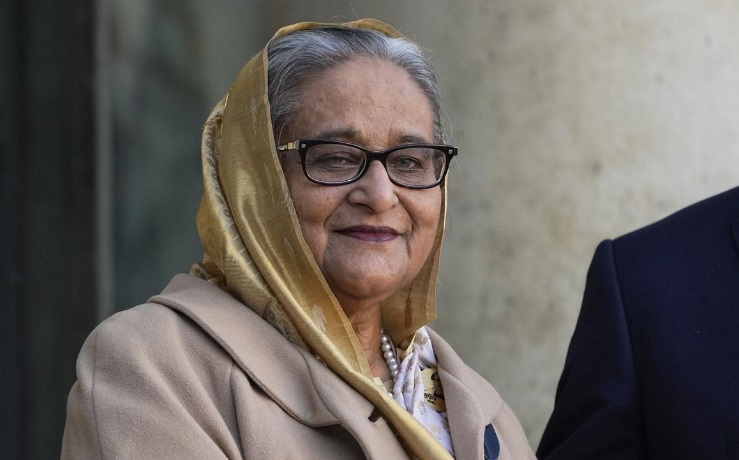
Dhaka: A Bangladesh court on Monday convicted ousted Prime Minister Sheikh Hasina of crimes against humanity, concluding a months-long trial that found she ordered a deadly crackdown on a student-led uprising last year. The special tribunal sentenced the 78-year-old former leader to death. Hasina had been facing multiple charges linked to the mass uprising that forced her out of office in August 2024.
The country’s International Crimes Tribunal (ICT-BD) on Monday delivered its verdict in the case against the deposed prime minister. Hasina was being tried in absentia over alleged crimes against humanity.
The three-member tribunal also pronounced judgment against Hasina’s two aides, former home minister Asaduzzaman Khan Kamal and former police chief Chowdhury Abdullah Al-Mamun, over the same charges.
What Are The Five Charges Against Sheikh Hasina
1. Incitement of violence and the killing of students at Dhaka University and other institutions, including the deaths of around 100 students and injuries to thousands during the July uprising. In a press conference at Gonobhaban, she remarked that if the grandchildren of Mukti Yodhas do not get jobs, then why should the grandchildren of Rajakars get them – a statement that stigmatises a section of people as enemies.
A telephonic conversation also surfaced in which she allegedly said to “hang the Rajakars.” She made aggressive remarks, claiming that the Chhatra League alone was enough to bring the situation under control. Allied organisations then launched systematic attacks on protesters at Dhaka University, leaving 297 students injured. There was a clear failure to take preventive and punitive action against the violence.

2. She held a telephonic conversation with Masood Kamal, then Vice-Chancellor of Dhaka University, instructing him to hang the students and “hang the Rajakars.” She also directed law enforcement agencies to kill protesting students and ordered their arrest. These directions were carried out by law enforcement agencies, who deployed helicopters and drones, resulting in the killing of 1,400 people and injuries to 2,500 others.
3. The protesters had announced a “March to Dhaka.” The Home Minister also proceeded. Six unarmed protesters were shot dead by the police, and these killings occurred with the full knowledge of Prime Minister Sheikh Hasina.
4. The Prime Minister had deployed helicopters, drones and lethal weapons to kill protesters. A pendrive containing the conversations has been played in the tribunal. In a conversation between Sheikh Hasina and Hasanul Inu, she stated that international agencies had told her it was a terror attack and instructed him to keep maintaining that narrative.
5. Serious violations of the human rights of the protesters occurred, including the killing of Abu Saaed on 16 July. Peaceful protests were suppressed, and indiscriminate firearms were used, resulting in indiscriminate shooting. An extrajudicial killing also took place during the March to Dhaka.
Notably, the country woke to near-empty toads with scattered cars and rickshaws moving through heavily policed intersections on Monday. The eerie calm followed a night of sporadic arson and crude bomb attacks.
Unidentified assailants set ablaze the vehicle-dumping corner of a police station complex and detonated two crude devices outside the residence of an advisory council member to the interim government Chief Adviser Muhammad Yunus. Multiple explosions were also reported at key intersections across Dhaka.
Reports fron Rangpur, Chattogram and other cities indicated a similar atmosphere with thin crowds and intensified patrolling by security personnel.
Authorities, already bracing for trouble after the now-disbanded Awami League called a two-day shutdown, ordered strict military, paramilitary and police vigilance.
Security forces mounted intensive patrols around the ICT-BD complex, the Secretariat, the Supreme Court premises, the Prime Minister’s Office and the diplomatic enclave.
Armoured carriers, water cannons, and riot-control units from the Rapid Action Battalion (RAB) and police were deployed at major junctions, while checkpoints screened movement into and out of the city.